Build a Nation Like a Forest
There's Room for Every Kind of Fungi
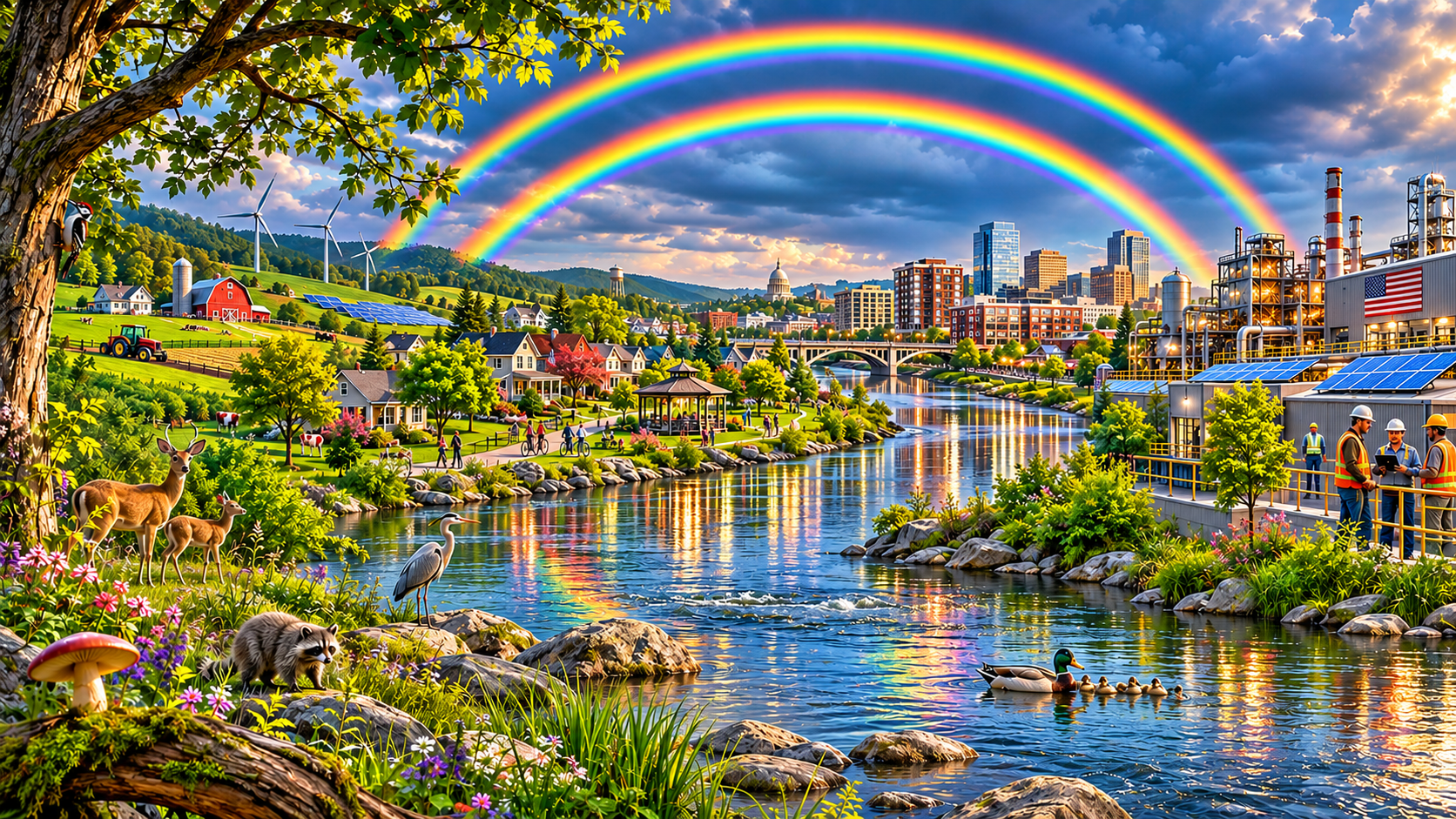
Imagine a beautiful forest on a warm summer morning. Sunlight dances through the leaves, birds sing their morning melodies, and a gentle breeze carries the fragrance of wildflowers across the forest floor. Beneath our feet, roots and fungi quietly exchange nutrients, while streams carry water to places we may never see. Every living thing has a role, and no two need perform the same one.
Now imagine a forest that doesn't merely sustain its inhabitants but creates opportunities for each to grow, adapt, and flourish.
Sound familiar?
America's Founders envisioned a nation built upon divided powers, individual liberties, shared responsibilities, and the pursuit of opportunity. They certainly didn't get everything right, but perhaps they understood something fundamental about building a lasting society: strength needn't come from uniformity.
A forest doesn't demand that every organism become a tree. Its resilience comes from the relationships among its many inhabitants. So why do we so often organize our infrastructure, industries, and even our expectations of one another as though there were only one way to succeed? And when it comes to energy, why do we continue extracting and consuming resources when nature offers us opportunities to capture, store, share, and reuse so much more?
Seventy-Seven to One
Seventy-seven to one. No, that's not a football score, although someone should probably check whether a few politicians have been playing without helmets. Buh dum dum, tss!
According to estimates compiled by the National Renewable Energy Laboratory (NREL), generating one kilowatt-hour of electricity from coal produces approximately 1,001 grams of greenhouse gas emissions, measured in carbon dioxide equivalents (CO₂e). Natural gas produces approximately 486 grams, solar photovoltaic systems 43 grams, and wind turbines just 13 grams. Nuclear power, deserving an honorable mention, also comes in around 13 grams.
These are life-cycle estimates, meaning they account for far more than what comes out of a smokestack. Mining, manufacturing, transportation, construction, operation, and eventual decommissioning are all part of the equation. And somehow, after considering those activities, coal still produces approximately 77 times the greenhouse gas emissions of wind power.
Remember playing with Tonka trucks as a kid? Imagine explaining to those children that, decades later, we'd still be digging up mountains of combustible material, hauling it across the countryside, and burning it to generate electricity when sunlight and wind have been arriving free of charge for billions of years.
Of course, capturing renewable energy isn't free. Solar panels and wind turbines require materials, manufacturing, land, maintenance, and eventual replacement. Battery storage introduces lithium extraction and additional environmental considerations, although recycling and technological improvements offer opportunities to reduce those burdens. And we should distinguish energy payback, the time required to generate the energy invested in production, from carbon payback and the financial time needed to recover an investment.
Yet the fundamental distinction remains: fossil-fuel generation requires a continuing supply of extracted fuel, while solar and wind infrastructure repeatedly harvest naturally replenished energy.
I wouldn't wager the house on every renewable installation being superior in every circumstance, but I'd certainly consider betting on the broader transition benefiting Americans, America, and the world. Especially when improving how we recover materials, reuse industrial sites, and restore damaged landscapes might allow us to begin repairing some of the harm we've already inflicted on the only planet in our solar system known to support life.
America's Aging Infrastructure — Rinse and Repeat? REALLY?!
America's industrial infrastructure has some remarkable stories to tell, and lately I've been fortunate enough to witness a few firsthand. Imagine walking through factories approaching 80 years of operation, encountering machinery that's been repaired, redesigned, modified, and borderline Frankensteined with little resemblance to its original configuration. Somewhere, perhaps, there's an operating manual lovingly punched out on a typewriter by an extraordinary secretary decades ago. Finding it might be another adventure entirely. Oh and any machines that need a 5.25” floppy disk? I knows a guys who knows a guys, but it’s gonna cost yous. No, I’m not joking. Someone makes them today, but imagine making that today so yeah, it’ll cost yuh.
There's something admirable about the ingenuity that keeps these facilities operating, but maintaining yesterday's machinery shouldn't prevent us from considering tomorrow's needs. These aging systems require continuing investments in maintenance, replacement parts, skilled labor, and occasionally substantial redesign. At some point, shouldn't we ask whether rebuilding what existed is preferable to building what could exist?
And why limit our imagination to existing industrial sites? Brownfields, closed landfills, abandoned facilities, and established transmission corridors offer opportunities to reconsider how America uses land already altered by human activity. Solar installations on former landfills, California's experiments with solar-covered canals, and potentially compatible wind installations along transmission corridors illustrate different ways to explore existing infrastructure footprints.
Not every location will be suitable, and environmental restoration must remain part of the equation. But the guiding question deserves consideration: What does America need today, and how can we design it to serve the America of tomorrow?
An FAA for Energy — A National Logistics Network
Surely, we can develop a national energy network that operates with the coordination and reliability of America's aviation system. And before anyone asks, yes, I'm serious, and don't call me Shirley. Now Linda, you should listen Linda, listen. 😉
Consider the Federal Aviation Administration (FAA), which establishes safety standards, manages air traffic, and coordinates an extraordinary network of airports, aircraft, airlines, and independent operators without requiring the government to own every airplane. Why shouldn't America's energy infrastructure benefit from a similarly coherent national framework?
We already have much of the institutional foundation. The Department of Energy (DOE), Federal Energy Regulatory Commission (FERC), North American Electric Reliability Corporation (NERC), state utility regulators, and regional grid operators perform important, sometimes overlapping functions. Rather than inventing another sprawling bureaucracy, imagine coordinating these organizations around a common national mission, somewhat like the federal reorganization that created the Department of Homeland Security following September 11, 2001. We can acknowledge the shortcomings of that reorganization while recognizing the value of improving cooperation among institutions.
Electricity generated in one region could more readily serve communities hundreds of miles away through expanded transmission networks, while coordinated forecasting, storage, and generation could help balance supply and demand. Just-in-time logistics would improve efficiency without sacrificing strategic reserves, redundancy, or emergency preparedness. America already maintains emergency supplies and strategic resources; dependable electricity deserves equally deliberate planning.
Frankly, electricity should have received this level of national attention decades ago. I'm looking squarely at political leadership across the past 30 or 40 years, regardless of party affiliation. How did something so essential to virtually every modern activity become so vulnerable to fragmented planning and competing priorities?
Government needn't own the companies generating, storing, or distributing electricity. Its responsibility would be to establish interoperable standards, coordinate national priorities, enforce reliability requirements, and protect the public interest while allowing private enterprise and local communities to innovate.
The destination isn't centralized ownership. It's coordinated opportunity.
Energy Doesn't Disappear
What if we stopped treating excess energy as an unavoidable waste product and started treating it as an opportunity? After all, energy doesn't simply disappear; it changes form (oh Einstein you silly goose), sometimes escaping as heat that could otherwise serve a useful purpose.
We already have remarkable ways to capture and store it. Sand batteries, molten salts, phase-change materials, and underground thermal reservoirs can retain heat for later use, while heat pumps can move and concentrate thermal energy with impressive efficiency. Electricity storage offers additional flexibility, allowing generation and demand to operate on different schedules. None of this requires inventing an entirely new branch of physics.
Consider a Dataport. Sorry, wrong article. Data centers. These facilities produce substantial amounts of heat while operating, yet we often design them primarily around getting rid of it. Why not design neighboring infrastructure to benefit from that thermal resource?
Imagine greenhouses supplying fresh tropical produce throughout northern winters, reducing dependence on lengthy refrigerated transportation and some of the preservation methods used to move produce across continents. Nearby aquaculture facilities, food processors, schools, hospitals, and residential districts could also benefit from appropriately conditioned recovered heat. Businesses might emerge to collect, store, distribute, and maintain these thermal resources, creating an industrial ecosystem rather than an isolated facility.
Could surplus heat even travel between distant regions? Perhaps, although moving electricity and producing heat locally may prove more economical than transporting thermal energy hundreds of miles. Let engineers and entrepreneurs compete to discover where each approach makes sense.
This isn’t even recreating anything. It’s reorienting what already exists, placing complementary businesses and infrastructure where their resources can serve one another. A forest doesn't waste every fallen leaf. Why is today’s economy designed to waste so much of what it produces?
The Fourth Dimension — A New American Energy Economy
Regardless of anyone's personal or political feelings about technology, the digital world is here, and it isn't packing its bags anytime soon. If current trends continue, our appetite for computing, communication, and electricity will only grow. Goodness gracious sakes alive, shouldn't we be learning from the good, the bad, and the ugly of previous industrial revolutions before building the next one?
Imagine the economic opportunities created by treating energy as a coordinated national resource rather than a collection of disconnected regional commodities. Companies could specialize in moving electricity between markets, operating distributed storage networks, recovering industrial heat, recycling valuable materials, or developing predictive maintenance systems that prevent failures before they interrupt service. Regional entrepreneurs could establish businesses around infrastructure that once served only a single industrial purpose.
The possibilities for improving electricity transmission and distribution alone could occupy researchers for years, and that's precisely the point. Government doesn't need to invent every solution, select every technology, or own the businesses that emerge. Establish common standards, protect fair competition, maintain public accountability, and allow American ingenuity to discover what works.
As technologies improve, materials are recovered, and unnecessary energy losses decline, the underlying costs of delivering electricity and useful heat can fall. Whether those savings reach households and businesses depends on competitive markets, responsible regulation, and preventing powerful interests from controlling access to essential services.
This isn't an argument for expanding government's reach into every corner of the economy. Quite the opposite. A properly designed national framework could reduce fragmented requirements, eliminate unnecessary duplication, and provide the predictable conditions entrepreneurs need to invest and innovate.
Environmental stewardship and economic prosperity needn't be opposing ambitions. Sometimes the most profitable thing we can do is stop wasting what we already have.
Oh Nelly, imagine that.
Government's Responsibility — The Rules of the Forest
Time for a little civics lesson, although I promise nobody needs to have grown up watching Schoolhouse Rock to participate.
Between the Declaration of Independence in 1776 and the ratification of the Articles of Confederation in 1781, Americans began translating revolutionary ideals into institutions of government. The Constitution followed in 1787, establishing a framework remarkable not because its authors were perfect, but because its principles could guide a nation confronting circumstances they could scarcely imagine.
Divided authority, individual liberty, accountability, and shared responsibility remain useful standards whenever America considers something new. Government establishes the rules, protects the public, and ensures those exercising power remain answerable for their decisions. Private enterprise supplies ingenuity, investment, competition, and the freedom to discover better methods.
For essential infrastructure, those rules should establish measurable outcomes: reliable service, transparent pricing, fair market access, environmental safeguards, and protections against manipulation or monopolistic behavior. Government needn't dictate how every business accomplishes those objectives, provided the public interest remains protected.
There's also a distinction worth making between industries we enjoy and infrastructure we depend upon. Entertainment enriches our culture and economy, but Americans can choose whether to purchase a movie ticket. Electricity, clean water, transportation, and communications are rather more difficult to decline.
And speaking of businesses, isn't it interesting that corporations weren't granted their own branch of government in our founding documents? Commerce certainly existed, but perhaps businesses should spend a little less time influencing politics and a little more time competing to serve the people those documents were written to govern.
Just sayin'. Sorry.
Oh wait. Not sorry. Not even a little bit on this and yeah…
As for national security, here’s something some may think is novel while those a bit more respectful of history may see the no der going on right muh her’, yeah, er mer gerd! Why not make national security the result of building a resilient nation, not the excuse for building one (Thanks Ike for teaching us all that). Diversified generation, domestic manufacturing, energy storage, and infrastructure capable of operating independently or together should make America stronger simply because we've designed it intelligently.
Cybersecurity? Absolutely. But if it's such a critical concern, why do so many of today's elected politicians—and I hesitate to call most of them leaders (and yes I know when to use em dashes, it’s called the Chicago Style Manual and yes this article is getting sassy)—seem comfortable with Americans' family videos, small businesses, school term papers, and personal information being entrusted to data infrastructure beyond our country's meaningful oversight?
For the sake of Pete, if we're going to build enormous computing capacity, shouldn't we design it to operate independently when necessary and together like a well-rehearsed orchestra when advantageous? One compromised conductor shouldn't silence every instrument. And consider the Megatons to Megawatts program, which converted uranium from dismantled Russian nuclear weapons into fuel for American power plants between 1993 and 2013. No, not Megatron, although Jetfire defected from the Decepticons, so perhaps even Megatron has redeeming qualities.
Imagine what else we might accomplish by redirecting resources once dedicated to destruction toward sustaining civilization. Here’s another bet I’d make, are you ready? I bet I’m not the only one who thinks a lot about this sad reality today, 😔🥺😎. Anyways, a stronger forest doesn't need a fortress around every tree. It needs roots capable of holding when the storms arrive.
A Green New Deal With Merit — Results Over Rhetoric
Republicans, Democrats, Greens, independents, and every political movement in between, consider this your invitation to do something truly revolutionary: get to work together.
America's politics of division aren't merely exhausting anymore. They're eroding the trust and common purpose that hold a nation together, and history offers some rather unpleasant reminders of what happens when those foundations collapse. Surely, we can address our energy future before discovering just how ugly that road becomes.
Here's a proposal: establish clear national objectives, create fair market rules, encourage investment through meaningful incentives, and let entrepreneurs compete to deliver the solutions. Government defines the outcomes, not every nut, bolt, wire, or business model.
Call it a Green New Deal with merit, provided merit actually means something. Publish responsibilities, implementation milestones, reliability measurements, environmental outcomes, consumer costs, and the results of public investments. Require periodic legislative reviews so successful programs can expand, unsuccessful ones can change, and political promises cannot quietly disappear after election season.
Does that sound like having our cake and eating it too? Absolutely. I'm hungry, I've got a sweet tooth, and if you put cake in front of me, I'll channel Joey Tribbiani and remind you that Joey doesn't share food!
And unless someone can convincingly explain how electricity became a Republican or Democratic commodity, perhaps we should hand the partisan combatants some tissues, give their political egos a well-deserved paddling, and tell them to GET TO WORK!
Americans don't need another slogan. We need results.
Some Moss Rolling Along For the Ride
Return with me to that forest. Trees capture sunlight, fungi recycle nutrients, water carries life through the landscape, and countless organisms compete, cooperate, and occasionally get themselves into a little more trouble. Somehow, amid all that diversity, the forest continues growing.
America has demonstrated similar resilience before. The original New Deal put millions to work building infrastructure, restoring landscapes, and strengthening communities during the Great Depression, helping establish foundations that would also support the nation's extraordinary mobilization during World War II. We haven't always gotten everything right, but goodness gracious, we've occasionally grown something remarkable.
There's a famous saying, often attributed to Winston Churchill, that Americans can be counted upon to do the right thing after exhausting every alternative. Whether he actually said it is another matter, but perhaps we've exhausted enough alternatives already.
Because ultimately, this isn't only about electricity, industry, or government. It's about creating a country where people have the freedom and opportunity to contribute in their own ways, while accepting responsibility for the ecosystem we share.
Not everyone wants to be a towering oak. Some prefer being mushrooms, and others may possess gifts we haven't even discovered.
There's room for every kind of fungi.
And who knows? That little mushroom might just be a pretty fun guy. 🍄
Conversation
No comments — and this piece isn't open for new ones.
Comments are closed on this piece.