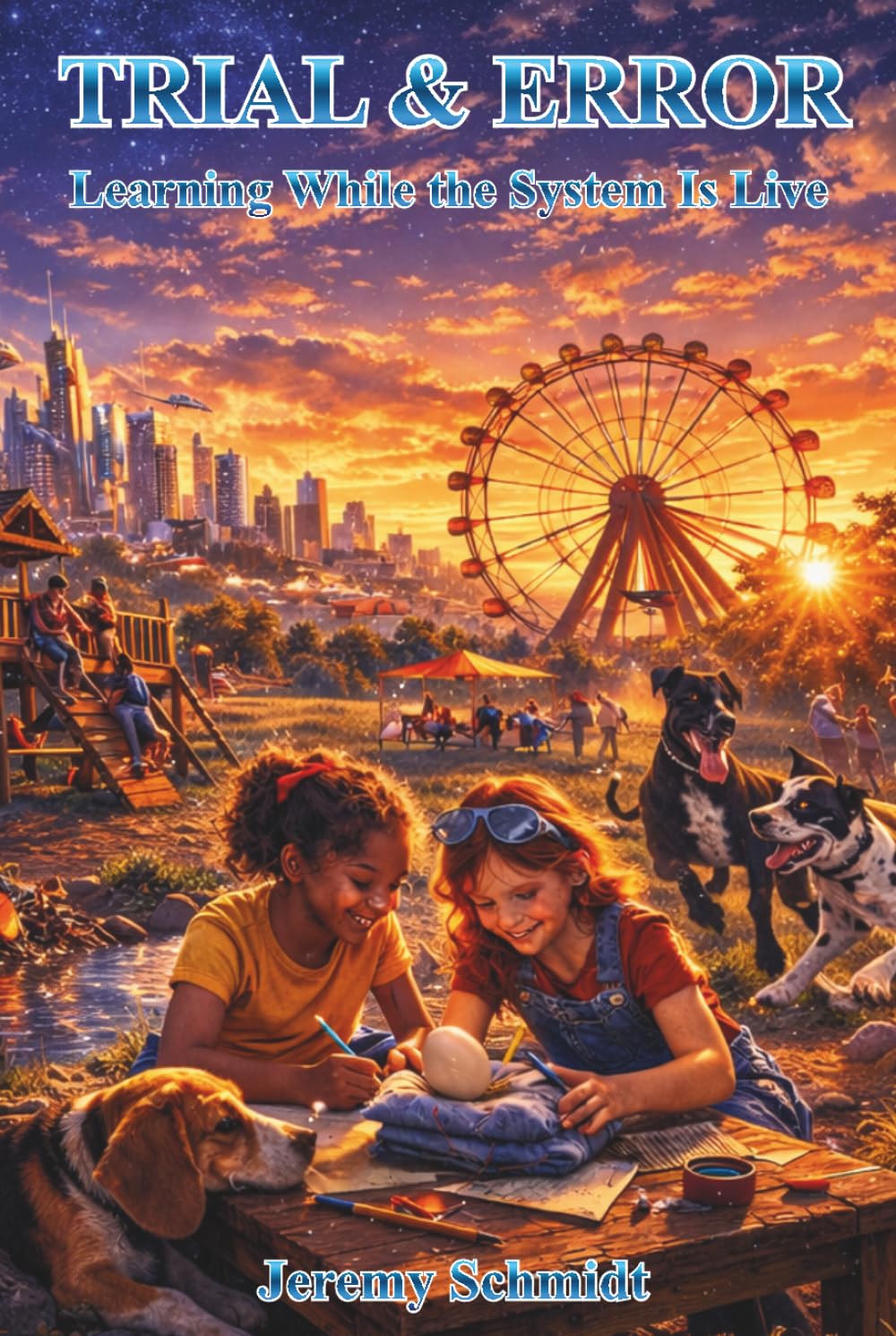
Trial & Error
Learning While the System Is Live
Theme — Growth rarely follows a straight line. Progress is built through experimentation, adaptation, setbacks, and persistence.
Purpose — Explore entrepreneurship, leadership, problem solving, and the lessons hidden inside both success and failure.
Most things worth building don't begin with certainty. They begin with an attempt. Trial & Error explores the messy space between an idea and whatever eventually becomes of it—the experiments, mistakes, revisions, wrong turns, unexpected discoveries, and occasional moments when something finally works. It is a book about progress without pretending progress is ever particularly tidy.
Synopsis
Trial & Error is about what happens after the idea.
Plans meet reality. Assumptions get tested. Experiments fail for reasons nobody anticipated. Good ideas occasionally turn out to be bad ones, bad ideas sometimes contain surprisingly useful pieces, and progress tends to arrive through a long series of adjustments rather than one brilliant breakthrough.
Drawing from creativity, entrepreneurship, science, technology, problem-solving, and ordinary life, Trial & Errorexamines experimentation as something more fundamental than a method. It is one of the ways human beings learn.
The book challenges our tendency to treat mistakes as evidence that something has gone wrong. Often, the mistake is the information. Failure exposes assumptions. Friction reveals weaknesses. Revision makes ideas stronger. And sometimes the most productive thing we can discover is that the direction we were confidently heading wasn't the right one at all.
Trial & Error isn't an argument for failing recklessly or celebrating every mistake. It's an argument for remaining willing to test, observe, reconsider, and begin again.
Because progress rarely arrives fully formed.
More often, we build our way toward it.
Conversation
No comments — and this piece isn't open for new ones.
Comments are closed on this piece.