Circle That Date… Wait, Which One?
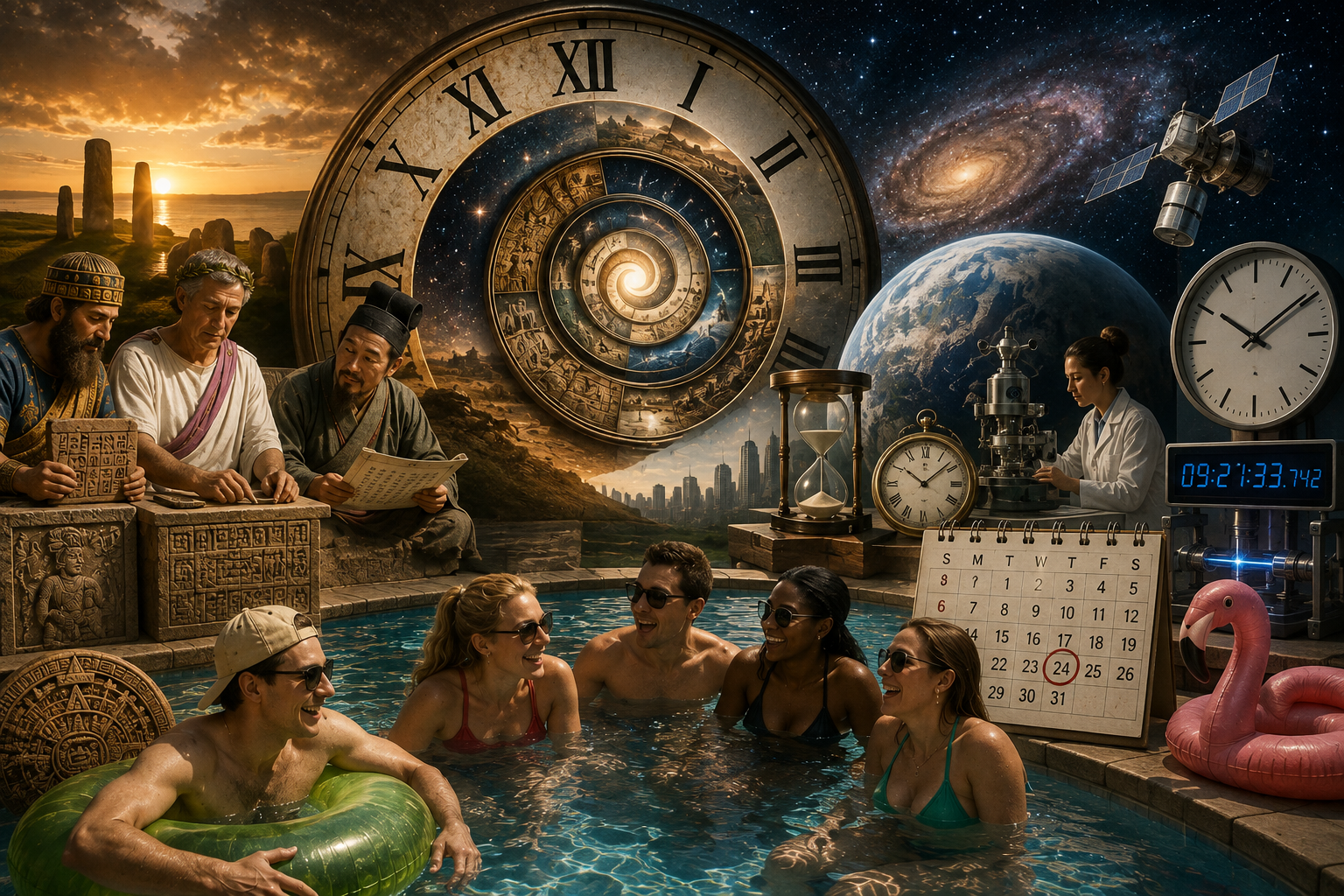
The laptop I’m typing this on is measuring time at speeds one might say are inconceivable. Its processor uses a clock to help control when work gets done. A processor running at 3 gigahertz cycles about 3 billion times every second, while memory has its own timing that helps coordinate when information can be moved, read, or written. That doesn't mean my computer completes 3 billion tasks every second, but those incredibly small slices of time help billions of electronic actions stay organized while I casually type a sentence.
Meanwhile, the little clock in the corner of my screen tells me what time it is. Humans have become almost absurdly good at measuring the stuff. Time, that is.
We don't even define a second by watching a clock anymore. Scientists define it using cesium-133 atoms, which provide an incredibly steady reference under controlled conditions. Count 9,192,631,770 periods of a particular radiation associated with the atom and, congratulations, a second has passed. Apparently nine billion wasn't quite precise enough. Newer optical atomic clocks are more precise still, enough that scientists can measure tiny differences in elapsed time between clocks placed at different heights. Gravity affects how quickly time passes, just as Einstein predicted, and our clocks have become good enough to catch it happening.
We can measure in the other direction just as impressively. Carbon-14 decay helps us estimate the ages of once-living things across thousands of years, while radioactive systems such as uranium-lead can date rocks across billions. Trees leave annual rings, ice builds layers and sediments settle over time, leaving natural records that can be read long after the moments themselves have passed. Even pulsars in space can provide remarkably regular signals that act something like enormous clocks in the sky.
Then there is light. It needs time to travel, which means looking across space is also looking into the past. We see the Sun as it was about eight minutes ago. Look far enough away and the light entering a telescope may have begun its journey millions or billions of years before anyone was around to wonder what time it was.
From the billions of tiny electronic beats happening inside the computer in front of us to rocks carrying clocks nearly as old as Earth, we have become remarkably good at figuring out how much time has passed. We can measure it across distances and scales our ancestors could hardly have imagined.
So this next question should be easy.
What day is it? (October, 🤭)
For all that precision, the answer to our simple question depends on whom we ask.
Most of us probably looked toward the bottom corner of a computer screen, pulled out a phone, or glanced at a calendar. The date staring back at us comes from the Gregorian calendar, now used for most civil and international business around the world. It is so common that it is easy to forget it is a system at all. January follows December, seven days make a week and every four years February usually gets an extra day. That's just how time works.
Except maybe it isn't.
Other calendars are still very much alive. Jewish, Islamic, Chinese, Indian, Persian, Ethiopian and Julian calendars continue to mark time for religious, cultural and sometimes civil purposes. Scientists, militaries and international commerce also rely on shared dating and timekeeping standards so everyone can agree on exactly when something happened, regardless of how that day might be labeled elsewhere. The same sunrise can therefore arrive with more than one perfectly valid date attached to it.
We even do this inside modern businesses. Manufacturers commonly use something called a "Julian date" to track production and shipments. Despite the name, it usually isn't Julius Caesar's Julian calendar. It is often simply the number of the day within the year: January 1 is 001, February 1 is 032 in a regular year, and December 31 is 365. Instead of printing August 24, a production system can call it day 236. Same day, different label.
That helps separate three things we often lump together. A clock measures duration. A calendar organizes days and repeating cycles into a system. A date tells us where we are inside that system.
We have become incredibly precise at measuring time. Naming it is another matter.
To understand how we ended up calling today what we do, we need to rewind the clock.
The calendar most of us use today didn't arrive fully formed either. Long before January through December became familiar boxes on a wall, Romans were already trying to keep their calendar lined up with the year around them. Their earlier systems changed over time and sometimes required extra days or even an extra month to keep the calendar from wandering too far from the seasons.
By the time Julius Caesar came along, it needed some work. With the help of astronomers, he introduced what became known as the Julian calendar. Its solution was remarkably close to the length of the solar year: 365 days, with an extra day added every four years. That averages out to 365.25 days per year.
Close, however, isn't the same as exact.
The solar year is about eleven minutes shorter. Eleven minutes isn't much. We can spend longer than that looking for our keys. But let eleven minutes pile up year after year for more than a thousand years and the calendar slowly moves away from the seasons and astronomical events it was supposed to follow.
That growing difference eventually helped lead Pope Gregory XIII to introduce a correction more than 1,600 years later, and increasingly precise adjustments to how we measure and keep time have continued since. The new Gregorian calendar changed the leap-year rules to keep the calendar more closely aligned with the solar year, and the countries that first adopted it skipped ten numbered dates to correct the accumulated drift. Other countries switched later, some much later, meaning neighboring parts of the world could use different calendar dates at the same time.
Nobody actually lost ten days. People still woke up, ate, worked, slept and aged through every one of them. What changed was the number humans wrote down to describe where they were in the year.
We didn't change time. We adjusted the calendar.
Rome was hardly alone in trying to make the sky fit neatly onto one. Across the world, civilizations developed their own ways of tracking the same Sun, Moon, seasons and passing days.
The Babylonians offer one of the oldest well-recorded examples. Their calendar was based heavily on the Moon, with months beginning around the appearance of a new crescent. Twelve lunar months, however, don't quite equal a solar year. Left alone, the months would slowly wander through the seasons. Their solution was wonderfully practical: occasionally add another month. Babylonian astronomers became remarkably good observers of the sky, recording the movements of the Moon, planets and eclipses with enough care that some of their observations can still be matched with astronomical events today.
More recently, at least in our cultural memory, the Maya gave the modern world a brief calendar obsession when December 2012 arrived and some people wondered whether the world was about to end. It didn't. What was actually ending was a major cycle in the Maya Long Count calendar, not time itself.
The Maya are especially useful here because they didn't rely on just one calendar. A 260-day cycle commonly called the Tzolk'in operated alongside the 365-day Haab'. Those cycles worked together to create a larger Calendar Round of about 52 years, while the Long Count provided a way to track much longer spans. One day could therefore occupy several different positions depending on which cycle someone was using.
Egyptian, Chinese, Ethiopian, Persian and many other cultures developed still other systems, some of which remain in use today. The details differ, but the underlying problem is familiar. Humans looked at recurring events around them and created systems for organizing where they were among them.
The Gregorian calendar isn't time. It's one of the coordinate systems humans created to describe where we are in it.
Not every calendar needs months, numbered years or little boxes hanging on a wall. Aboriginal Australian peoples developed seasonal calendars based on the environments where they lived. There is no single Aboriginal calendar; different groups recognize different seasons, sometimes five, six or more. Changes can be marked by rainfall, winds, the flowering of certain plants, animal behavior or the appearance of stars. Various African traditions have likewise used the Moon, stars, rainfall, agriculture and other natural cycles to mark the passage of time.
Instead of simply saying August 24, another way of keeping time might tell you that a particular flower is blooming, an animal has returned and certain stars are appearing in the sky. One answer isn't necessarily better than the other. They may simply answer different questions.
Oddly enough, that brings us right back to where we started. Ancient people watched nature to measure and organize time. Today we use atomic transitions, radioactive decay, Earth's movement, tree rings, ice, sediment and signals from distant objects in space. Our instruments have become almost unimaginably more precise, but we're still doing something remarkably familiar.
We're watching nature.
A culture doesn't need numbered years to understand the passage of time, just as an atomic clock doesn't need January to measure a second. Thousands of years of calendars and modern science share a basic idea: find something in nature that changes, repeats or leaves a record, and use it to help figure out where we are.
Then physics makes things weird again. Time isn't one universal clock ticking at exactly the same rate everywhere. Motion affects elapsed time, and so does gravity. The differences are usually tiny for us, but atomic clocks can measure them, and GPS satellites have to account for relativity to keep their timing—and our locations—accurate.
Humanity: We finally built an unbelievably accurate clock.
Universe: Great. Now move it.
This is where our hypothetical time traveler should start taking notes. Traveling through time also means figuring out where everything will be when you get there. Earth rotates while orbiting the Sun, the Sun moves through the galaxy, and the galaxy is moving too. "Same place" becomes a surprisingly complicated instruction when the place itself never stops moving.
Science fiction has at least played with the problem. Star Trek gave us Stardates, an attempt to leave familiar Earth calendars behind and describe time for people traveling through space. The fictional system has changed over the decades and isn't exactly a working lesson in physics, but the basic instinct makes sense. Once we're no longer standing together on Earth, simply asking for the date may not tell us enough.
Our would-be time traveler needs more than a clock. They need coordinates.
Apparently, we're not done tinkering with calendars either. Modern proposals have included the International Fixed Calendar, with thirteen 28-day months; the World Calendar, built around four regular quarters; and the Hanke-Henry Permanent Calendar, designed so dates fall on the same weekdays every year. Each tries to make our calendar a little more orderly, but replacing something already woven into governments, religions, businesses and billions of lives is easier to propose than actually do.
Leaving Earth, however, may eventually give us a reason to start over. A day on Mars, called a sol, lasts about 24 hours and 39 minutes, while a Martian year lasts about 687 Earth days. Our familiar days are close, but our months and years don't fit very well at all. Several Martian calendars have already been proposed, and if people ever live there permanently, they'll need some way to organize work, seasons, birthdays and another trip around the Sun.
Perhaps Star Trek wasn't being quite so silly after all. The calendar we know makes sense for the planet where we created it. Somewhere else, humans will probably create another one.
After all of this, we still wake up, glance at a phone or little box on a wall and say, “That's today's date.” It is. It's just not the only answer humans have come up with.
Maybe that's the more interesting part. Whatever time itself ultimately is, keeping track of it seems remarkably human. We have watched shadows, stars, moons, seasons, flowers and floods. We have counted days, months, years and cycles. Eventually we built mechanical clocks, atomic clocks and instruments capable of reading time from radioactive decay and light traveling across the universe. We keep finding more precise ways to measure it and new ways to organize it because we keep asking the same basic question.
Where are we now?
The answers have changed across cultures, centuries and continents, and someday they may change again on another planet. Yet the desire to know seems to follow us everywhere.
So go ahead. Circle that date.
Just make sure we agree on the calendar first.
Conversation
No comments — and this piece isn't open for new ones.
Comments are closed on this piece.