Here, Lemme Snap You Somethin’
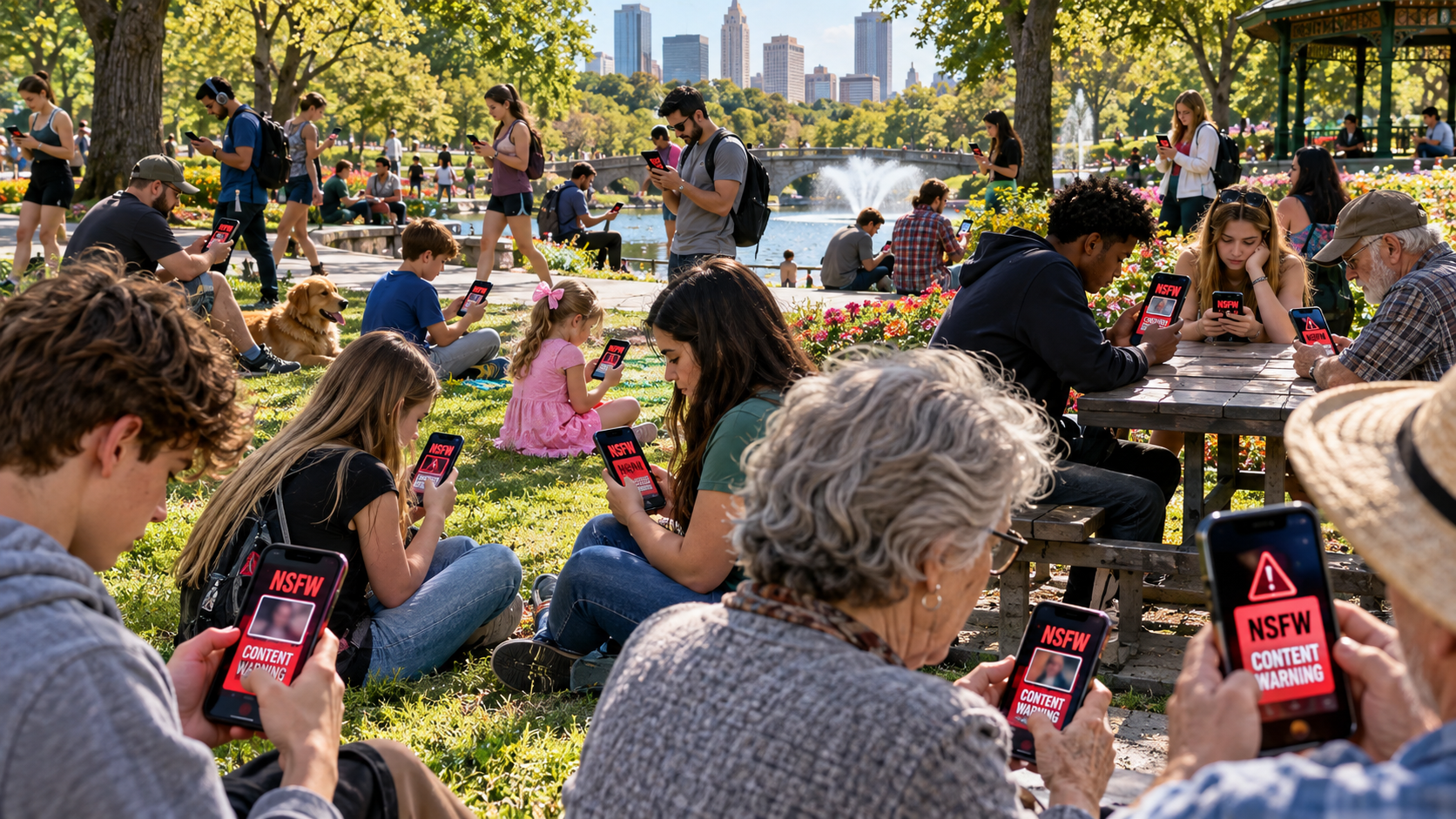
Now, I've shared a fair amount about myself. Some posts even show a little skin. Nothing beyond PG, mind you. Yet the more I've shared, the more unsolicited offers of personal pornography have appeared. And wowsers, do these people know how to sell!
The introductions. The compliments. The attempts to establish rapport. The special offers. The urgency. The follow-ups. Even the objection handling! I've encountered enough sales pitches to wonder whether someone is conducting a digital remake of Boiler Room.
Always be closing… apparently.
The scripts are so repetitive that I sometimes wonder whether they're all attending the same training seminar. And when one pitch doesn't work, another follows. Perhaps a different price. Perhaps a different approach. Perhaps another photograph I never requested.
Now, before anyone thinks I'm singling out women, I've encountered some rather immature adult men peddling their personal porn, too. Let's just say my responses to those little boys are considerably less accommodating. It's quite clear how Mr. Affleck's selling skills built another empire down the road in Gotham. When it comes to these boys on Snapchat, I often conclude our chats with a reminder:
"I'm Batman."
But beneath the absurdity of these encounters is something I find increasingly troubling. These aren't merely people sharing intimate photographs with willing recipients. They're approaching strangers, initiating unsolicited sexual propositions, and treating ordinary human interaction as an opportunity to close a sale.
And as I've discovered, some of them have considerably more than one sales technique up their skirts.
Of all the sales techniques I've encountered on Snapchat, perhaps the most peculiar is the damsel in distress. Somewhere between the friendly introductions and the increasingly familiar propositions, a young lady will reveal that life has dealt her a rather unfortunate hand. Rent is coming due, groceries are scarce, or some unforeseen emergency has left her in desperate need of assistance. And wouldn't you know it, we've only just become acquainted.
Now, I have considerable sympathy for people facing genuine hardship, and I certainly don't begrudge someone asking for help when they need it. But there's something rather extraordinary about discovering that a complete stranger has not only entrusted me with her financial troubles but also possesses a remarkably convenient means of resolving them. Oh, you have Venmo? How convenient, Miss Woe-Is-Me! Sometimes an offer of personal porn even accompanies the request, as though compassion might require a little encouragement before reaching for its wallet.
Is this Our American Girl?
The absurdity would be considerably easier to dismiss if I weren't thinking about the people who might welcome these approaches for entirely different reasons. In 2023, the U.S. Surgeon General warned of an epidemic of loneliness and isolation, a condition that makes the promise of companionship especially meaningful to someone who rarely experiences it. Imagine a fellow who has spent another evening alone, perhaps recovering from a divorce or mourning someone he loved, when an attractive stranger suddenly takes an interest in him. What begins as an unexpected conversation might become something he looks forward to, particularly if the attention gradually takes on the appearance of affection.
And therein lies the disturbing possibility. A person seeking connection may find himself investing emotionally in someone whose interest was commercial from the beginning. By the time the financial request arrives, he may no longer regard it as a transaction at all, but as an opportunity to help someone he believes cares about him. Our damsel has found her rescuer, although I can't help wondering which of them was truly vulnerable.
Of course, there's still another party to this peculiar arrangement: the company providing the place where these conversations unfold. Our damsel may be hoping to collect a payment, but Snapchat has an entirely different reason to value the interaction.
In earlier articles and posts, I've discussed the attention economy as a logical consequence of the Information Age. After all, information is competing for our attention, and the more information we produce, the more valuable that attention seemingly becomes. But while discussing the subject recently, I realized I might have overlooked something rather significant. Human beings have always competed for one another's attention. From the town crier to the newspaper advertisement, the radio commercial to the television screen, attracting an audience is hardly a modern invention.
What is relatively new is our ability to turn nearly every interaction with that audience into something measurable, repeatable, and commercially valuable. Perhaps we've moved beyond the attention economy into something more accurately described as the engagement economy.
Consider the distinction. Someone might devote twenty uninterrupted minutes to reading an article without clicking a single thing, while another person spends those same twenty minutes scrolling, reacting, messaging, and moving between dozens of unrelated subjects. Both have given their attention, but the latter has generated a stream of measurable interactions. And those interactions can help digital platforms learn what keeps us coming back.
Algorithms encourage engagement. That's a fact, JACK!
Now consider Snapchat, with its recommendations, private messages, disappearing content, and opportunities to connect with strangers. These features may serve perfectly legitimate purposes, but they also provide an environment in which unsolicited propositions can flourish. How effectively does Snapchat identify repeated sexual solicitation, enforce its policies, or protect people who never invited these approaches in the first place?
There was a time when even Playboy came wrapped, yet here we have intimate sexual propositions arriving through an everyday communication application. Snapchat didn't invent the people making these offers, but it certainly operates the showroom in which I've encountered them.
And while the company deserves scrutiny for the environment it provides, let's not overlook the people making the decisions to exploit it. You may not know, so let’s see what we can find.
Empowerment or Exploitation?
I've spent considerable time considering what empowerment means, particularly when the word becomes a convenient defense against questioning someone's behavior. In my earlier article on toxic femininity, I explored how femininity, social expectations, and cultural permission can be used to manipulate or diminish others while presenting those very actions as expressions of strength or independence. And I can't help seeing that same contradiction in some of these Snapchat encounters.
Consider a woman who deliberately cultivates a stranger's affection, recognizes his loneliness, or appeals to his compassion, all with the intention of extracting money. She isn't simply exercising control over her own body. She's attempting to exercise control over someone else's emotions and, ultimately, his wallet. When that manipulation is celebrated as empowerment, I believe we've confused personal freedom with permission to exploit.
Sexual autonomy is not a license to exploit. Empowerment is not immunity from accountability. And when that empowerment becomes a means of manipulating another person, we may need to consider whether the empowered has become the abuser.
Which brings me to a question I've increasingly wanted to ask: Ladies, what are you doing with your bodies?
I'm not asking because I believe women should surrender their autonomy or because every adult who creates sexual content is exploiting someone. I'm asking what happens when personal porn becomes so normalized that intimate images are treated as ordinary merchandise, affection becomes a marketing strategy, and an entire generation grows accustomed to selling access to itself.
The choices belong to the individuals making them, and so does the responsibility. But there's a larger problem waiting beyond this discussion of adult autonomy.
Because the environment in which all this is happening isn't reserved for adults, not even close.
Parents, Your Children Are Participating NOW
Here's a distinction I find particularly disturbing. OnlyFans, a platform associated with the sale of adult content, restricts participation to adults and requires creators to verify their age and identity. Snapchat, meanwhile, generally permits children as young as thirteen to create accounts without universally requiring government identification during registration.
Thirteen!
That's not even high school for many children. And frankly, I don't think high school is an appropriate place for this nonsense either. Yet here we have a communication platform accessible to young teenagers, operating in a digital environment where I've personally encountered unsolicited offers of personal pornography.
Now, Snapchat prohibits sexually explicit content and solicitation under its policies, but writing a prohibition and effectively enforcing it are two very different accomplishments. If strangers can approach me with these propositions, what prevents similar approaches from reaching someone who isn't old enough to understand the manipulation, recognize the risks, or appreciate the consequences of responding?
Parents, do you know who's messaging your children? (Wow, flashback to 80s late-night TV commercials…ok, I’m back) Do you know what photographs they're receiving, what requests they're making or being asked to fulfill, and what they believe they're supposed to do to earn attention or affection? Children aren't merely waiting on the sidelines of this digital culture until adulthood grants them admission. Some are already participating, whether as recipients, willing initiators, or young people “seizing on a market opportunity” whose consequences they may not fully comprehend.
And this is where the subject becomes considerably more personal for me.
I have daughters.
I think about the world they're growing up in, the messages they'll receive about their bodies, and the people who may someday attempt to convince them that their worth can be measured in photographs, attention, or money. I want them to understand the difference between affection and manipulation, between confidence and commercial exploitation, and between being valued as human beings and being treated as products.
Perhaps there's a lion in me after all. Not some king defending his throne, but simply a father determined to protect his daughters. And frankly, I'd be more worried about an ordinary lion than a king. Kings want to keep their power. Lions want to protect their cubs.
And once we recognize that children are already part of this environment, I don't believe we can leave the responsibility at Snapchat's doorstep. Because wait, there’s more!
Open the Aperture
But why stop at Snapchat? If we're going to question the responsibility of a company providing access to this environment, shouldn't we also consider the companies making that access possible? Apple, Google, the app stores, operating systems, and device manufacturers all participate in an ecosystem that places extraordinarily powerful communication tools into the hands of children, often accompanied by assurances about safety, parental controls, and appropriate content.
Remember when adult magazines came wrapped? (This one is for you brothers.) Society recognized that certain material wasn't intended for children and took measures to keep it out of their hands. Today, we purchase smartphones presented in packaging so attractive that people sometimes keep the boxes long after the devices are removed. Beautifully designed, carefully arranged, and practically inviting us to tear them open.
We wrapped the magazines. Then we dressed up the boxes and handed our children devices.
And parents, we're part of this sitch, too. We purchase the devices, approve the apps, and sometimes go about our lives without ever fully understanding the “toy” we just “gifted” them.
But if Snapchat prohibits sexual solicitation, as its policies suggest, why are unsolicited propositions still finding their way into my conversations? More importantly, what confidence should parents have that those same approaches aren't reaching their children?
The aperture has widened considerably, but the original question remains.
“Snapchat et al., what are you actually doing about it?”
Always Be Closing? Not This Time
I can already hear the objection: “If Snapchat bothers you so much, why don't you just delete it?”
Because I'm not finished.
I want to know whether there's something worthwhile beneath this parade of personal porn sales pitches. Genuine friendships, meaningful conversations, creativity, perhaps even a little human connection without a price tag.
But deleting an application doesn't resolve what happens to everyone who stays, especially the children.
So, Snapchat, Apple, Google, and everyone else profiting from this digital showroom: If you can't keep the salespeople away from the children, what exactly are you selling us?
Always be closing?
Not this time
Conversation
No comments — and this piece isn't open for new ones.
Comments are closed on this piece.