Leave the Clock Alone
I am remarkably indifferent to daylight saving time. The clocks move forward, the clocks move back, and my body apparently shrugs. I don't notice some great loss of sleep in the spring or glorious restoration of it in the fall. I change the clocks (ha, gotcha. We all know short of a microwave they change themselves, the little buggas) and continue about my day.
That isn't everyone's experience, and I know it. For some people, the clock change genuinely disrupts sleep, routines, moods, kids, pets, work schedules, and the general willingness to participate pleasantly in civilization for a few days, even weeks. There are legitimate health and safety questions surrounding the transition, too. So, when the semiannual debate arrives over whether we should finally stop doing this, I have traditionally occupied the least useful position possible:
Sure.
Whatever.
Then I wondered why.
Shocker.
Why do we change the clocks at all? Not why did somebody originally propose it, which is an interesting historical question of its own, but why is moving the clock still our chosen way of dealing with seasonal daylight?
That question becomes considerably more entertaining once you notice that daylight saving time does not, in fact, save daylight. Nothing happens to the amount of sunshine available because we rename the hour in which it occurs. Last anyone checked, Earth's rotation, orbit, axial tilt, our latitude, and the time of year have already settled that matter without requesting our input.
What we're really doing is changing the clock so we don't have to change our schedules.
If the Sun rises at what standard time calls 5:15 a.m., daylight saving time calls that moment 6:15. If sunset would be at 8:30 p.m., we call it 9:30. We haven't moved the Sun or stretched the day. We've collectively decided that an hour of sunlight at the beginning of the day would be more useful to many of us at the other end.
That's not necessarily foolish. In fact, it's rather clever. Instead of asking millions of people to start work an hour earlier, we move the clock and let millions of people continue saying, “I start work at eight.”
Relative to the Sun, they don't.
LEAVE IT ALONE!
Benjamin Franklin inevitably meanders (possibly stumbles; we all know his favorite invention) into this story. He's frequently credited with inventing daylight saving time, but that's giving him credit (or blame) for something he didn't quite propose. While living in Paris in 1784, Franklin wrote a satirical essay observing that people could save candles by getting out of bed earlier and making use of morning sunlight. He joked about ringing church bells and even firing cannons to wake people who refused to cooperate.
Beneath the satire was a much simpler observation. Morning sunlight already existed. People could simply alter when they used it.
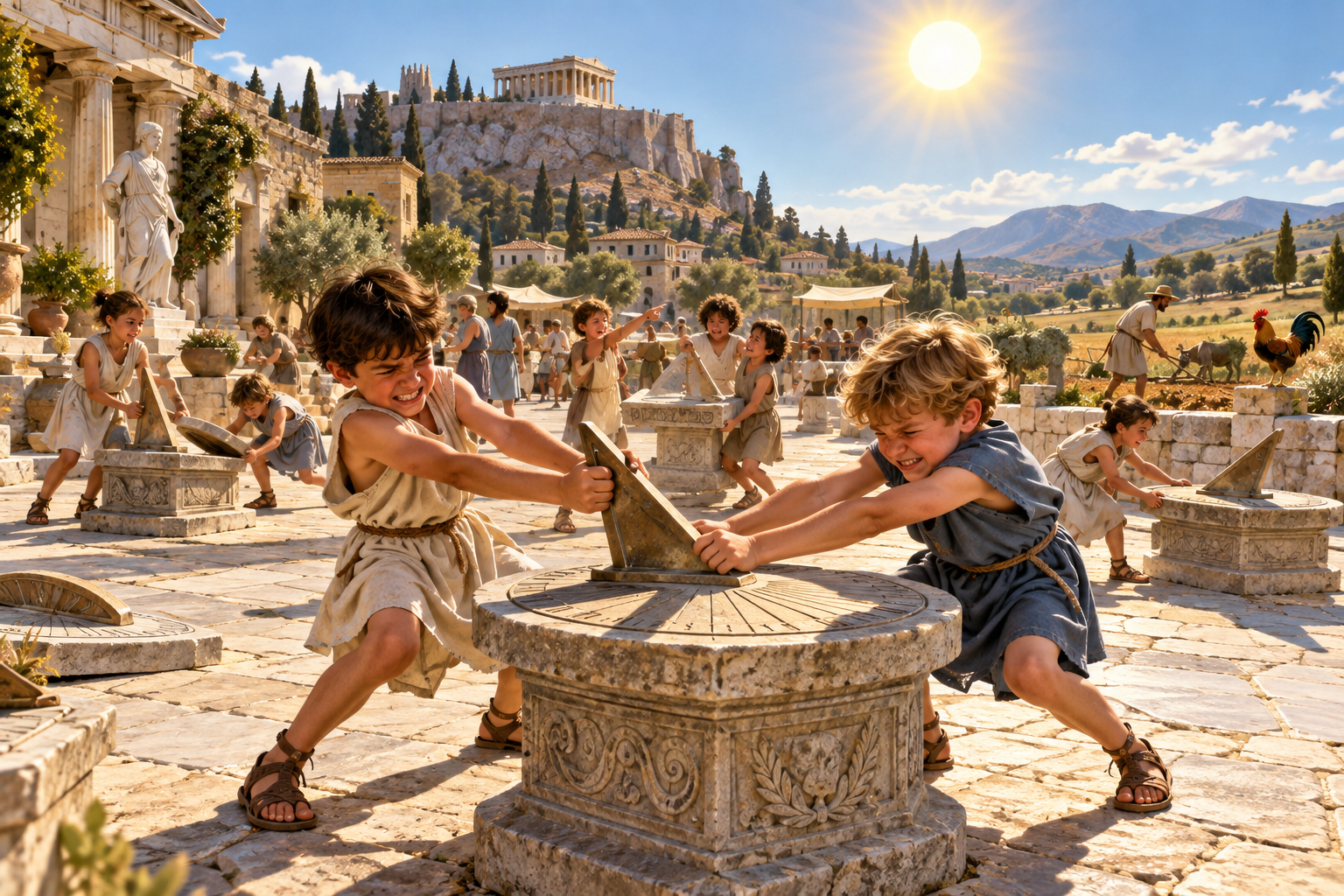
Excuse me, I just pictured a bunch of kids running around ancient Athens twice a year, moving all the sundials, and I may have tinkled. 😂
Modern daylight saving time developed through other advocates and eventually became tangled up with war, energy conservation, commerce, legislation, and the need to coordinate enormous numbers of people. Today, however, much of the argument isn't about whether seasonal daylight should influence human activity. It's about whether we should keep moving the clocks twice a year or pick one time and stick with it.
Permanent daylight saving time usually gets the sexier (time can be attractive) sales pitch. Later summer sunsets mean more time after work for pontoons, friends, sports, walks, grilling, lakes, kids playing outside, or doing absolutely nothing while the Sun remains above the horizon. In Wisconsin, where winter occasionally feels like the Sun has entered a witness-protection program, that extra evening daylight is not difficult to appreciate.
And daylight saving time arrives in spring, right about when we begin emerging from our houses again. Another Pleasant Valley Sunday.
So perhaps we should simply keep daylight saving time all year.
Except we've already tried that.
I'm betchaing y'all (a Midwest/Southern remix and totes 4th-wall break?) didn't know that.
The United States tried year-round daylight saving time during the energy crisis of the 1970s. It was supposed to run from January 1974 through April 1975. Americans made it nine months before Congress changed course.
On paper, Americans rather liked the idea. Then winter arrived and everyone discovered an inconvenient property of daylight: if you move an hour toward the evening, you have to take it from somewhere. Would you care to guess where it came from? That's okay, I'll tell you. Morning.
Children went to school in darkness. Commuters started their days before sunrise. Early-shift workers were well into their mornings before the Sun joined them. Public enthusiasm dropped, and Congress reversed course.
That little experiment is worth remembering because permanent daylight saving time remains the intuitive answer for many people who want the clock changes to stop. Americans got a fairly large trial run and discovered that “later sunsets” and “later sunrises” feel rather different when experienced instead of polled.
That pushes us toward permanent standard time, which also happens to be the option generally preferred by sleep and circadian researchers. Morning light plays an important role in synchronizing our biological clocks, and standard time keeps civil time more closely aligned with the solar day.
Fine. Standard time it is.
LEAVE IT ALONE!
Then summer arrives in Wisconsin.
Under permanent standard time, the daylight we currently enjoy later in the evening doesn't vanish. It returns to the morning, which is where daylight saving time borrowed it from in the first place. At our latitude, sunrise during part of the summer begins wandering into four-something in the morning.
Nature seems perfectly satisfied with this arrangement. Human beings who went to bed at eleven may feel differently. And this is where farmers get unfairly dragged into the conversation, because one of the most persistent bits of daylight-saving folklore is that we started doing all of this for them.
Farmer Brown: Don't drag me into this.
Crops don't know what time it is. Livestock don't reset themselves at two in the morning because the government changed the clock. Plants respond to sunlight, temperature, moisture, and season (possibly sound; different article). Animals respond to daylight and biological rhythms. Farmers have always had to organize human activity around natural conditions because nature has shown remarkably little interest in accommodating our calendars.
The rooster, notably, could not be reached for comment. He had been up since dawn singing his little heart out. Leave it to a farmer and rooster to get me wondering whether there's a misdiagnosis going on. Cock-a-doodle-doo!
The Earth rotates and travels around the Sun on a tilted axis. That creates seasonal changes in daylight, and those changes become more dramatic with latitude. Miami and Minocqua do not experience the same summer or winter daylight. Anchorage? Fuhgeddaboudit! Yet much of the country applies essentially the same one-hour clock adjustment to all of them. And notably, a few places have decided “meh” to changing clocks altogether. Interesting, huh?
The Sun is the one thing in this discussion that absolutely refuses to negotiate. We built clocks to measure and coordinate ourselves around it. Then we built schedules around the clocks. When daylight and our schedules don't line up particularly well, we've chosen to change the thing sitting between them.
Maybe that's the germ. Not daylight saving time itself. Not standard time. Not even the twice-yearly transition. Maybe we've spent more than a century trying to optimize the clock when what we actually wanted to optimize was ourselves.
We increasingly let algorithms do exactly that. Give a system changing conditions, geography, demand, or performance data, and the next thing we all know we’re being charged more for delivery during Packers’ games. We have dynamic routing, smart thermostats, traffic management, predictive scheduling, and machines that respond to conditions in real time.
Then we look at ourselves.
“It's eight o'clock. We start at eight.”
But why?
Suppose Wisconsin simply remained on standard time. A workplace that operates from 8:00 to 5:00 during winter could operate from 7:00 to 4:00 during summer. The workday hasn't become shorter. The Sun hasn't moved. The clock hasn't moved. We've simply adjusted our schedule to the season.
Tell Wisconsinites you're taking away an hour of their summer evening and you may have a fight on your hands. Tell them they get off work at four all summer and suddenly this becomes a very different conversation.
Nor is this some radical experiment in human adaptability. I recently encountered a Wisconsin manufacturer whose employees rotate through shifts beginning at six, seven, and eight in successive weeks before starting the cycle again. Every three weeks those employees accommodate more recurring variation than moving between winter and summer office hours would require in an entire year.
The work still gets done.
Perhaps the strangest assumption buried inside the daylight saving debate is that our schedules are the fixed variable.
They aren't.
A construction crew might prefer six to two during summer or even longer shifts with more days off. An office might choose seven to four. Restaurants may have no reason to change at all. Hospitals and factories have lived outside the mythology of the universal eight-to-five workday since their doors first opened. Schools already consider age, transportation, safety, local sunrise, and community needs instead of inheriting the same answer as everyone else. High school, for as long as I can tell, has started before elementary school, and that's not just because little Jimmy won't get out of bed.
And latitude matters. A seasonal schedule useful in Wisconsin might be unnecessary in Florida and inadequate in Alaska. That's not a flaw in the idea. It's recognition that the daylight we're responding to isn't the same everywhere.
Maybe daylight saving time was ingenious precisely because it solved a huge coordination problem cheaply. Instead of persuading millions of people and institutions to change their schedules, change the clock and everyone moves together. Eight remains eight even though, relative to the Sun, everyone just started an hour earlier.
That's genuinely clever. Maybe it's also worth asking whether we still need to solve the problem the same way.
We already change our hours all the time. Businesses alter staffing according to demand. Schools stagger start times. Factories rotate shifts. Seasonal businesses change hours. We coordinate teams across continents. Maybe changing a workday once in spring and once in fall isn't quite as radical as it sounds.
Maybe the problem isn't that daylight keeps changing throughout the year and across latitude. That's not a problem at all. That's simply the planet we gratefully live on.
Maybe the problem is that we keep expecting one fixed human schedule to fit it.
Benjamin Franklin, annoyingly, may have been circling the answer before anyone had a wristwatch to reset. Farmers have understood their version of it forever. The Sun comes when it comes. Use the daylight when you have it.
Farmer Brown can go back to work.
The rooster is already there.
And if somebody somewhere is secretly responsible for controlling the British crown, keeping the metric system down, and deciding what time the rest of us think it is, perhaps we can finally take one item off their workload. Hey, I never said I don't espouse a conspiracy theory or two or three or four or more. 👅
The Sun can keep doing what it does. Standard time can keep measuring it. And the rest of us can decide how best to arrange our lives around both.
We don't need to keep changing the measurement because we're reluctant to change the behavior.
So perhaps, after more than a century of springing forward, falling back, arguing about which one should become permanent, and occasionally trying one only to change our minds later, we've finally earned the right to stop messing with the thing in the middle.
LEEEEEEEEEAVE IT ALOOOOOOOONE!
Conversation
No comments — and this piece isn't open for new ones.
Comments are closed on this piece.