The Call Is Coming From Within
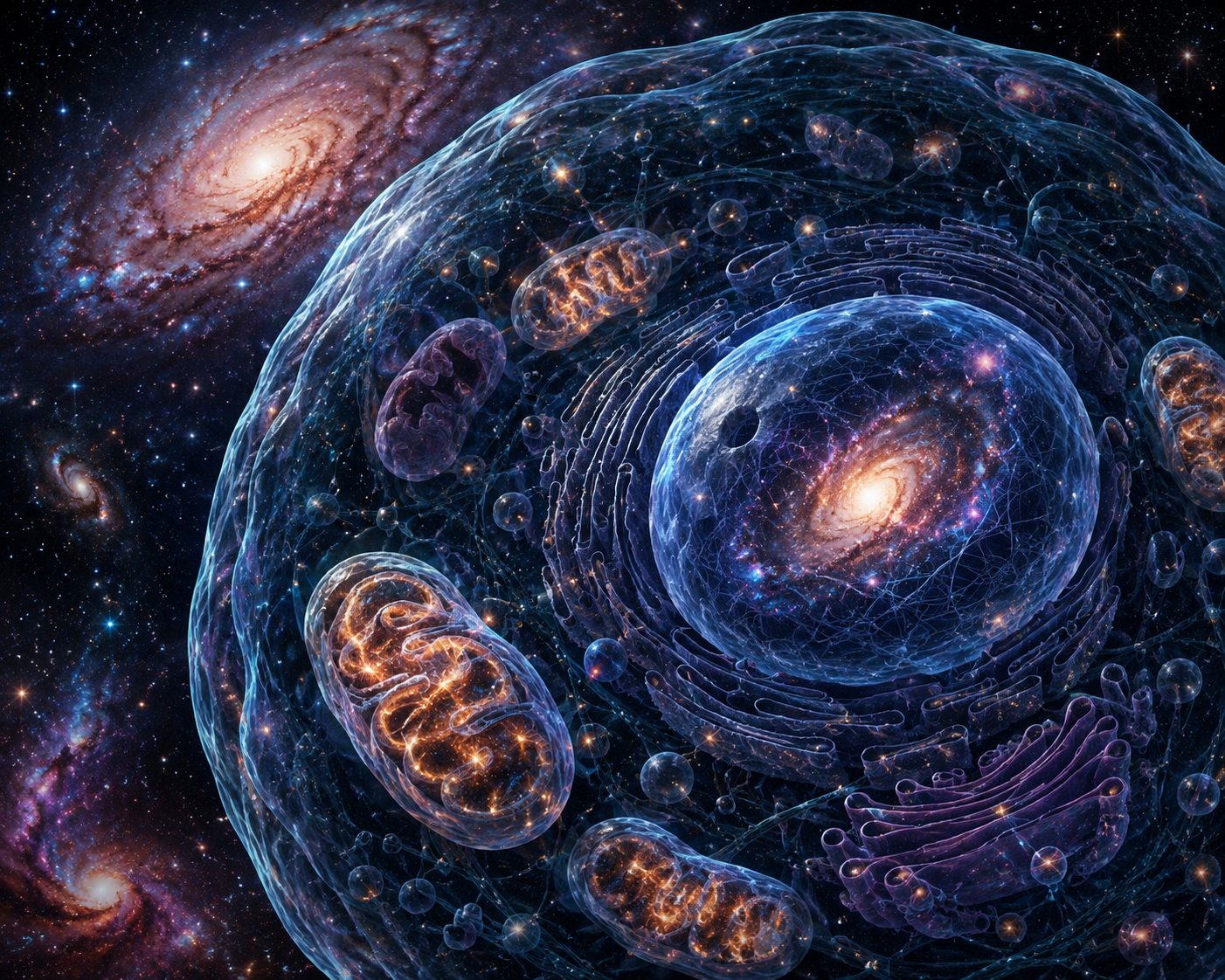
Not so long ago, something strange happened. Admittedly, “not so long ago” is doing an unreasonable amount of work in that sentence, because our story begins billions of years ago, give or take a few hundred billion. At that distance, even science has to become comfortable with a little uncertainty.
What the evidence allows us to say with considerably more confidence is that two very different forms of microscopic life became intimately connected. One belonged to a bacterial lineage, and although scientists continue to investigate exactly how that ancient relationship began and developed, somehow their histories became intertwined. What may have started as an encounter between separate forms of life became, across an almost incomprehensible span of generations, something neither a hermit crab borrowing a shell nor a houseguest overstaying a welcome (three days according to Ben) could adequately describe.
The descendants of that bacterial lineage became increasingly integrated with the cells they inhabited. Much of their former independence disappeared, genes were lost or transferred, and the relationship became so complete that today we don't generally think of the participants as separate organisms at all.
Which makes this a rather peculiar alien-abduction story, because after many moons it has become difficult to say where the alien ends and the host begins.
You probably know the descendants of that ancient stranger by another name: mitochondria, the “powerhouses of the cell.” It is one of those wonderfully useful descriptions we learn in school that manages to be completely correct while barely hinting at the spectacle underneath.
Because mitochondria aren't some obscure biological artifact preserved from a distant past. They are working inside most of your cells as you read this, carrying traces of that ancient history in their own DNA while helping power the living system you casually refer to as yourself.
The scale of this ancient partnership is difficult to appreciate. Most of our cells contain mitochondria, and cells with enormous energy demands can contain thousands of them. Across an entire human body, estimates can reach into the quadrillions, although counting mitochondria is considerably less straightforward than the word “counting” suggests. They constantly divide, merge and change shape.
For perspective, astronomers estimate that our Milky Way contains somewhere around 100 to 400 billion stars. We cannot count those precisely either, but the comparison is enough to make the scale remarkable. At a quadrillion mitochondria, the human body would contain thousands of Milky Ways’ worth if every mitochondrion were represented by a star.
There are no tiny galaxies inside us, of course…of course... There is something arguably more magnificent: a living human body operating at a scale we rarely stop long enough to consider.
For all this talk about ancient organisms and microscopic galaxies, mitochondria are still doing something remarkably practical. They are helping keep us alive. To understand how, we need to ask a question so elementary that most of us probably stopped asking it sometime around elementary school.
Why do we breathe?
The obvious answer is oxygen. We breathe because our bodies need it, which is perfectly true and explains almost nothing. Why do we need oxygen?
With each breath, oxygen enters the lungs and reaches tiny air sacs called alveoli, where it crosses into the bloodstream. Most of it catches a ride on hemoglobin inside our red blood cells, travels through an extraordinary network of blood vessels, and is eventually released into tissues throughout the body. From there, oxygen can diffuse into cells.
We could stop here and comfortably declare that oxygen keeps our cells alive, but that would be a little like explaining that gasoline makes a car go because you put it in the tank. Something still has to happen under the hood.
So, with a respectful nod to Ms. Frizzle, let's get smaller.
Much, much smaller.
Inside the cell, we find our mitochondria again. Oxygen has made an impressive journey to get here, but it is not quite the fuel we often imagine it to be. Much of that comes from the food we eat. Oxygen has another job waiting for it, and to understand that job we have to follow something even smaller. Oh yeah, the best things are in small packages.
The electrons.
The electrons we are looking for arrive carrying energy originally harvested from food. Through a series of chemical reactions, that energy is packaged into molecules capable of delivering high-energy electrons to machinery embedded within the mitochondrion's inner membrane. Here begins what biologists call the electron transport chain, although the name makes something extraordinary sound suspiciously like warehouse logistics.
As electrons move through this molecular chain, some of their energy is used to pump positively charged hydrogen ions, or protons, across the membrane. Suddenly there are more positive charges on one side than the other. The mitochondrion has created both a chemical imbalance and an electrical one—an electrochemical gradient, in the proper terminology.
Nature does not waste the imbalance. Those protons want a way back across the membrane, and much of that return traffic passes through a molecular machine called ATP synthase. If the name sounds mechanical, the reality is even better: part of ATP synthase actually rotates as protons flow through it.
Somewhere in the Matrix, the machines are taking notes.
That rotation helps join ADP with phosphate to produce ATP, the small energy-carrying molecule cells use to power an astonishing range of activities. Muscle contraction, cellular maintenance, building molecules and countless other processes ultimately depend on a usable supply of it.
Step back for a moment and consider what just happened. Energy extracted from food moved electrons through molecular machinery. That movement helped separate electrical charge across a membrane. The resulting gradient drove a rotating machine that converted the stored potential into another form of chemical energy the cell could use.
Without announcing it, our biology lesson wandered straight into chemistry, physics and electricity.
And we still haven't explained why we breathe.
This is where oxygen finally gets its turn.
The electrons moving through the transport chain need somewhere to go. At the end waits oxygen, which serves as the final electron acceptor. Without it, that orderly flow begins to back up, the proton gradient cannot be maintained normally, and the mitochondrial machinery responsible for producing most of our ATP can no longer keep operating as it did moments before.
That is, at the cellular level, a large part of why we breathe. Every trip our lungs make into the atmosphere helps supply the oxygen that keeps this extraordinary process moving. Breathing supports circulation, circulation delivers oxygen, and deep inside our cells that oxygen allows the flow of electrons—and the production of usable energy—to continue.
But oxygen does not simply disappear after doing its job. At the end of the chain, it combines with electrons and protons to form something considerably more familiar: H₂O.
Water.
We spend our lives drinking it, bathing in it, swimming through it and watching it fall from the sky, yet some of it is also being made inside us. Water is not merely something life requires from its surroundings. Aerobic metabolism produces it as part of the chemistry of staying alive.
If this sounds like an extraordinary piece of human machinery, there is one more complication: it isn't particularly human.
Apes and monkeys have mitochondria. So do birds, fish and insects. Keep walking through the living world and the circle continues to expand, reaching plants and fungi as well. Plants may be the more surprising addition. We learn early that they use sunlight to make sugars and release oxygen through photosynthesis, but their cells also contain mitochondria that use oxygen in cellular respiration.
The deeper we look, the older the story becomes. Mitochondria were around long before humans, primates or even animals appeared. Their ancestry reaches deep into the history of complex cellular life, and variations of this ancient arrangement now exist across an enormous range of organisms.
So perhaps our original alien story needs one small correction. The stranger wasn't simply something that became part of us.
It became part of a family much larger than we imagined.
At this point, science fiction starts looking a little less fictional. Star Wars gave us midi-chlorians, microscopic life forms living inside cells and connected to something much larger. Star Trek has repeatedly imagined organisms living inside other organisms, sometimes with considerably less cooperative intentions. Even Frozen II wandered into surprisingly relevant territory with its playful insistence that water has memory. Science does not validate every leap those stories make, of course, but good fiction has never required that. It takes something possible, something observed or sometimes simply something imagined, then turns the knobs to see what happens.
This would seem like the perfect time to start talking about extraterrestrial life.
Screeeeeech.
Hard left. We're staying on Earth.
Meet the tardigrade, a microscopic animal capable of surviving environmental extremes that would kill most familiar forms of life, including exposure to the vacuum of space when protected by its remarkable dormant state. Then travel to the deep ocean, where entire ecosystems gather around hydrothermal vents without sunlight, supported by microbes using chemical energy from their surroundings. Turn out the lights while we're down there and some organisms solve that problem too, producing their own through bioluminescence.
This cute little guy doesn't require science fiction. It’s already here.
Before we decide what alien life should look like—or what conditions ought to be too strange for life at all—it may be worth remembering how spectacularly weird one living planet has already become.
Perhaps we shouldn't be surprised that living things interact with an electromagnetic world. Water, ions and electrons are everywhere in biology, while our nerves, muscles and even the machinery inside mitochondria depend on moving or separating electrical charge. Vision itself begins when electromagnetic radiation—light—interacts with molecules in our eyes.
Other creatures add stranger abilities. Some fish detect electric fields, while birds and other animals can use Earth's magnetic field as part of their navigation. Experiments have even found that certain weak radio-frequency fields can disrupt magnetic orientation in birds.
That raises an interesting question. Humans have filled our surroundings with radio, cellular networks, Wi-Fi, electrical equipment and countless other artificial electromagnetic sources. Could some of that electronic noise occasionally obscure natural signals that living things evolved to detect?
That is a question, not a conclusion. Different frequencies, strengths and biological mechanisms matter enormously. But perhaps electromagnetic noise deserves the same basic curiosity we eventually gave light and sound pollution.
Life, after all, did not evolve in an electromagnetic cone of silence.
Now, finally, we can talk about aliens.
We do not know whether life exists anywhere beyond Earth, much less whether it would have cells, DNA, mitochondria or anything else we would immediately recognize. What we do know is that the ingredients and rules behind life here are not exclusively ours. Water exists elsewhere. Carbon is abundant. Electromagnetism does not stop at the edge of our atmosphere, and chemistry does not consult an Earth-specific rulebook.
That leaves a wonderful question rather than an answer. If life has emerged somewhere else, would it discover some of the same solutions? Perhaps not mitochondria themselves, but ways to move electrons, separate charge, store chemical energy or build boundaries that function something like membranes.
Evolution and life elsewhere, if it exists at all, could have taken paths we cannot begin to imagine. Yet it would still be working within the same universe.
Maybe the truly universal language isn't biological.
Maybe it's physics. Maybe.
We began what seems like forever ago with a microscopic stranger and somehow ended up looking toward the universe. Along the way, we traveled inside our own cells, followed electrons through molecular machines, watched oxygen become water, and discovered that some of the strangest ideas in science fiction have plenty of competition right here on Earth.
Perhaps someday we will learn whether life found another path somewhere among those billions of stars. Until then, there is already an extraordinary universe waiting much closer to home, powered in part by descendants of something that was once decidedly foreign.
We went looking for the alien.
The call was coming from within all along.
Conversation
No comments — and this piece isn't open for new ones.
Comments are closed on this piece.