The Layers We Live In
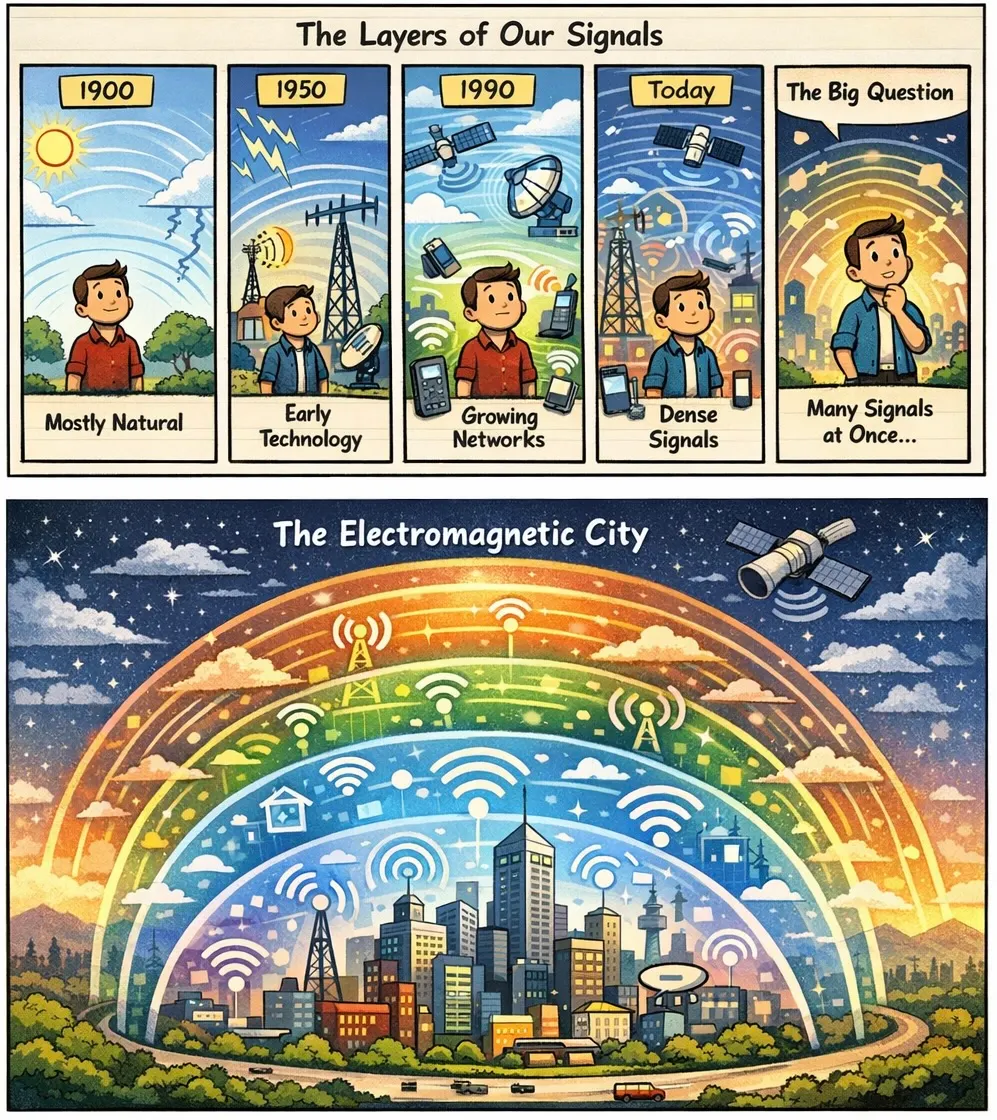
For most of human history, the air around us carried only a small set of signals. Not silence, but simplicity — sunlight, lightning, and the Earth’s own electromagnetic field. These were the background conditions in which human biology developed, adapted, and stabilized over time.
That simplicity has changed.
Over the past century, we have gradually introduced new layers into the electromagnetic environment. The early 20th century saw the rise of broadcast radio. By the mid-1900s, television signals and more advanced transmission systems began to spread. Toward the end of the century, cellular networks, satellites, and personal electronic devices expanded that landscape even further.
Today, those systems do not exist in isolation. They operate simultaneously, continuously, and in close proximity to nearly every person. Wi-Fi routers, cell towers, Bluetooth connections, GPS signals, and satellite communications form a dense and overlapping network that surrounds modern life. We no longer move in and out of connectivity. We exist within it.
What makes this shift notable is not simply the presence of more signals, but the nature of their accumulation. Estimates suggest Americans spend the vast majority of their time indoors and often carry multiple connected devices — each one transmitting, receiving, or both. Exposure is no longer intermittent or distant. It is constant, layered, and concentrated in the spaces where we live, work, and rest. The difference isn’t any one technology — it’s the environment created when all of them operate together.
Electromagnetic exposure is not uncharted scientific territory. EMFs span a wide spectrum, from low-frequency fields associated with power systems to higher-frequency signals used in wireless communication. Organizations such as the Federal Communications Commission and international health bodies have established guidelines intended to limit exposure to levels considered safe based on current evidence. Those guidelines exist because the question has been taken seriously.
Most of the underlying research, however, has been developed through studies that isolate individual variables — specific frequencies, particular devices, or defined exposure scenarios. This approach is necessary for controlled study and has produced important insights into how electromagnetic fields interact with biological systems.
What it has not fully addressed is the cumulative effect of multiple signals operating simultaneously, particularly over long periods of time.
This is not a claim of harm. It is an acknowledgment of complexity.
When environments change gradually, it is easy to overlook the scale of transformation. Each technological addition has been introduced for clear and often beneficial reasons — improving communication, enabling mobility, and expanding access to information. Viewed individually, these innovations have been studied, regulated, and widely accepted.
Viewed collectively, they form something new.
In situations like this, it is reasonable to ask broader questions. What does continuous exposure, rather than occasional exposure, mean for the human body? Could signal density influence aspects of daily life such as sleep quality, cognitive load, or baseline levels of stress? Are there subtle, long-term effects that are difficult to detect when systems are studied in isolation?
These are not conclusions, but areas where understanding may still be developing.
There is historical precedent for this kind of reassessment. In other domains — materials, chemicals, and environmental systems — society has often adopted innovations first and studied their long-term impacts later. In many cases, the initial assumptions were directionally correct, but incomplete. Over time, a more comprehensive view emerged, informed by prolonged exposure and broader patterns of observation.
The electromagnetic environment may represent a similar dynamic. It was not designed as a single system, but built incrementally, layer by layer. A transmission tower here, a wireless router there, a device in every pocket. Each step made sense in context. Together, they have created a condition that did not previously exist.
That condition is now the baseline.
The question moving forward is not whether any individual technology is safe within established limits. It is whether the totality of what we have built — operating continuously, across every space we inhabit — is fully understood in its long-term effects.
If the last century was defined by the expansion of connectivity, the next may be defined by a deeper examination of the environment we now live inside.
Conversation
No comments — and this piece isn't open for new ones.
Comments are closed on this piece.