What a Cool Can!
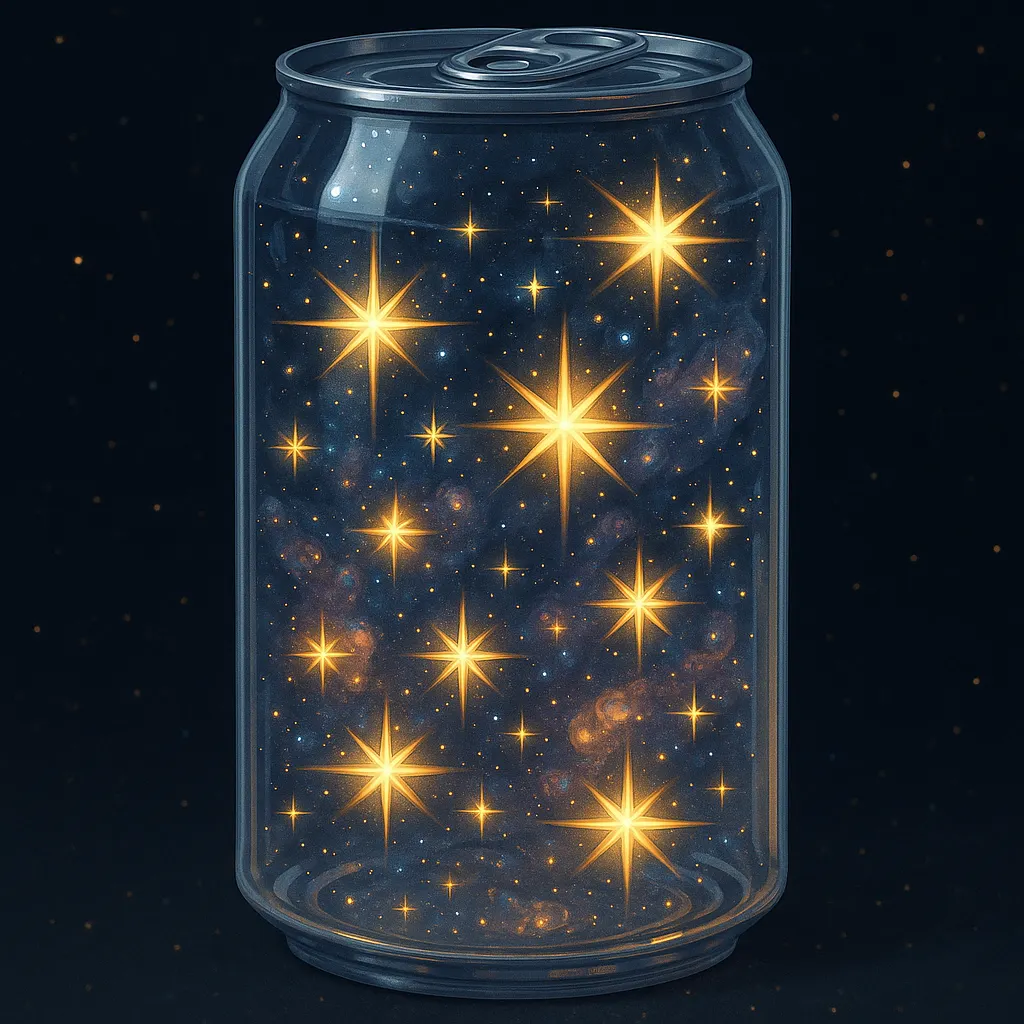
If you agree math is an idea and like idea you can play with it. If math is nothing more than numbers and numbers can easily be made up, let’s combine the two and see what math can do to ideas.
Quickly too, in physics and thermodynamics, the way I understand them being the backyard physicist I pretend to be, is that the words excite and excitement can be used to described the effects of particles heating up. Ok, hopefully, that isn’t farfetched. And what if since we all get excited about money, we just simply call it excitement for a little while.
The idea of excitement (money) artificially added into a system, and how a structure responds when it wasn’t designed for that level of excitement. This will help us understand what happens economically when a nation pumps money into a system that mathematically does not require it to increase productivity.
Okay — back to the science room.
Truly, who doesn’t love a little fire?
Middle school science class. Safety goggles. Burners. Chaos.
The Middle School Science Teacher (wherever you are, thank you) has already set up fifteen lab stations. Each station has two aluminum cans, a water basin, a towel (South Park creators, is ok if it’s understood we “Don’t forget to bring a towel!”), and two kids whose “curiosity quotient” is peaking. Why would a teacher give 30 kids fire to play with? Well, that’s a different story.
Everyone knows today is a good day.
We all heat the cans at the same time. Fifteen burners. Fifteen cans. Fifteen pairs of kids who definitely shouldn’t be trusted with fire, yet here we are. As the cans heat up, we know not to touch the metal — life taught us that years before we ever understood thermodynamics.
Inside the can, the air molecules start racing around.
Excitement = money.
Add heat → molecules get more excited → pressure builds inside the can.
Nothing “happens” to the outside of the can at this stage, but something is happening:
the structure of the can is weakening — just a tiny bit.
Most of us don’t notice that part, but it matters. Then the moment comes. The Teacher announces,
“Okay everyone — goggles down! Three… two… one!”
We flip the cans into the water.
BOOM! (Oh you bet it was a Big Bada Boom!)
Fifteen cans collapse inward all at once, each with its own violent crunch. Metal buckles. Sides fold. A few fly back so quickly you’d think a ghost punted them.
Every group screams. The class is electric.
And, of course, one universal chant rises:
“Again! Again! AGAIN!”
Luckily, each station has a second can — The Teacher knew exactly what he was doing. So we heat the second round of cans. This time the kids swear the cans are turning red-hot (they aren’t, but you know). The excitement in the room matches the excitement in the cans. Pressure is building everywhere.
Everyone braces for round two.
But suddenly:
“Okay,” The Teacher says calmly,
“could everyone please place the can gently on the towel next to your water basins?”
Collective groan.
“Awwwww!”
“Noooo!”
“We want the BANG!”
Instead, he smiles and says,
“You know what? Let’s go outside for a bit.”
The class erupts.
Who expects a recess during a middle school science class?
After about 30 minutes, we all come back inside.
Checking first, The Teacher touches his own can, and verifies it’s safe. The cans — once blazing hot — are now cool to the touch. He asks the class now to place the can in the water.
And this time?
Nothing.
No violent reaction.
No dramatic implosion.
No crushed sides.
The cans simply float, peacefully, in harmony with the water.
Then comes the most important question of the whole experiment — asked by a kid who was absolutely ready for chaos:
“What happens if we keep heating it up even more? Like…
WAY hotter?”
And The Teacher gives the most middle-school-mind-
blowing answer possible:
“If you keep adding heat — if you keep increasing the excitement inside the can — it will eventually explode.”
And for anyone who’s never done this experiment in class, you already know the adult version:
toss a spray can into a fire. Same same.
Too much excitement → too much pressure → Kaboom. Kablooy. Kapoot.
Now here’s the part where science meets math meets economics.
What if excitement (= money) is artificially added into a system that doesn’t require it to thrive, the system doesn’t become more productive.
It becomes more unstable.
Just like the can:
Add excitement suddenly → violent collapse (implosion).
Add excitement continuously → violent explosion.
Let the system cool and settle → harmony.
If a can helps understand this for you, here is something more. A repeated pattern of heating the can and letting it cool certainly maintains the can’s integrity, but who likes getting burned?
Now here’s another twist:
Everyone keeps using the word “productivity” like it means “getting more out of the same thing." But that’s not what productivity actually is — not mathematically and not physically.
Real productivity is like discovering an entirely new can, or using the celebrity star analogy, is placing another star inside the system that works with the system. Mr. DeGrasse Tyson will hopefully agree that stars have, are today, and will tomorrow create another star in the universe, but they all still become stars here, in our little can.
Productivity isn’t squeezing more out of one system until it bursts.
It’s building another system that can generate and hold its own excitement. Or harnessing the very stars that the system already gives us.
Where can more cans or more stars be found?
Conversation
No comments — and this piece isn't open for new ones.
Comments are closed on this piece.