Did You Hear What Jimmy Did?
From Puritans to Punk Rock
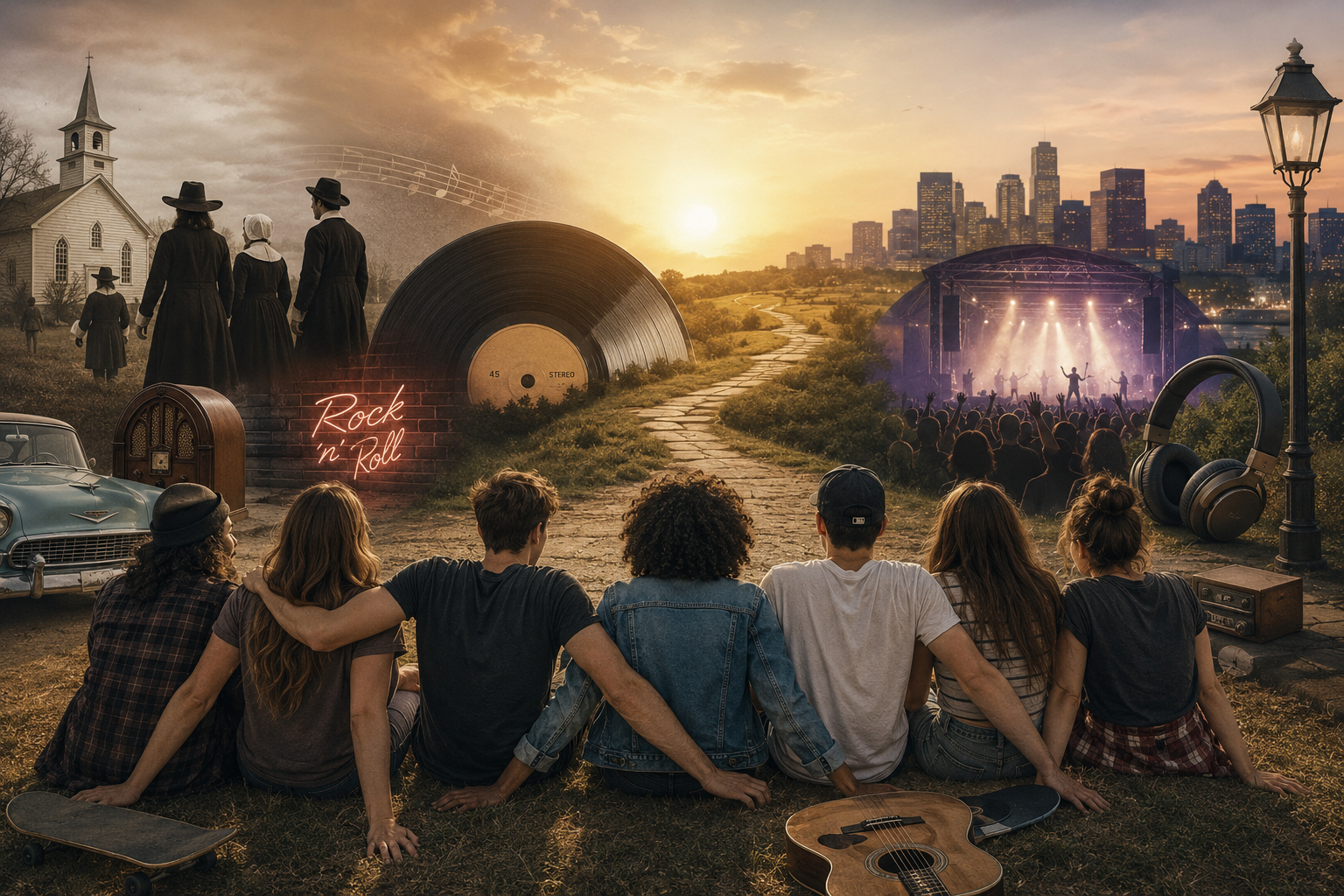
Nobody wants to work anymore. Young people are entitled, parents aren't parenting, entertainment is vulgar, sexual standards are slipping, and community has given way to self-interest. Millennials heard it. Gen Z hears it louder.
The Puritans said it too.
In fact, they complained about nearly the same things. Materialism, idleness, sex, drinking, clothing, entertainment, parenting and individualism. The pattern became so familiar that scholars have a name for it: the American jeremiad.
Puritan warnings notwithstanding, people kept being people. By the eighteenth century, a Yankee Doodle could dance, court and steal a kiss, perhaps sharing a cup of kindness for auld lang syne. Somehow the rock of ages remained standing, and so did civilization.
Then Elvis moved his hips.
Rock and roll was loud, suggestive and, depending on whom you asked, capable of putting American youth on a fast track outta the house and into jail. Teenagers were all shook up. Their parents were less impressed. After a hard day's night worrying about where the kids had been, what they were listening to and whom they were with, a little respect probably didn't seem like too much to ask.
Then four young men arrived from Liverpool with hair that apparently required immediate attention.
Girls screamed. Teenagers crowded around televisions. The Beatles could command that kind of attention eight days a week, while plenty of adults wondered what exactly had gotten into their children. Looking back, Beatlemania also looks suspiciously like an early blueprint for something later generations would recognize immediately: put a few young men together, give them good vibrations and distinctive hair, then stand back.
The decade kept moving. Hemlines rose. Hair grew. Young people came together around music, civil rights, war, peace and ideas that increasingly belonged to them rather than their parents. The times really were changing, and people are strange when the world they understood starts changing with them.
Parents wanted something different for their children.
Then again, you can't always get what you want.
The children kept growing up, and by the 1970s plenty of parents were again asking what was going on.
Divorce was rising. Sexual norms were changing. Drug use had become harder to ignore, religious participation was shifting, and traditional ideas about marriage and family were being challenged. To adults watching the culture move beneath their feet, there always seemed to be a bad moon rising somewhere.
Young people, meanwhile, still wanted somebody to love.
School got out. They gathered with friends, searched for good times and occasionally reminded nervous parents to take it easy. Music changed with them. Rock splintered in every direction, punk arrived with considerably less interest in behaving itself, and disco filled clubs with flashing lights and people who intended to keep dancing as long as they were stayin' alive.
O-o-h child.
By the end of it all, even the idea that we are family was being reconsidered, debated and rebuilt. There were changes everywhere, although perhaps not quite the collapse some feared.
Then came the dancing queens, the freaks and one more generation determined not to stop until it got enough.
Somehow, September always became October.
And the kids kept growing up.
By the 1980s and 1990s, another generation was under pressure and increasingly convinced its parents knew almost nothing.
The feeling was mutual.
Parents worried about drugs—occasionally explained to their children with their breakfast—along with sex, violence, divorce and entertainment. Their children wanted to express themselves, find somebody to love and, sometimes, simply have fun. Everyone seemed certain the other side was crazy. Perhaps they were all livin' on a prayer.
The kids hadn't started the fire. They were made in a world already changing around them, while rock and roll spread far beyond its beginnings. Some of it was made in England, some came roaring out of Boston or Chicago, and increasingly it didn't matter where the sound began. Music could cross borders almost as quickly as young people could decide it was theirs.
Hip-hop told them to fight the power. Pop told them to look at the man in the mirror. Girls wanted to dance with somebody. Whether things were black or white, kids wanted freedom right now and increasingly expected to come as they were.
Prince seemed particularly well suited to the moment. It was a sign of the times: wear a raspberry beret if you wanted, kiss somebody if they wanted you to, and when the world became too serious, perhaps everyone could just go crazy for a while. Purple rain was apparently as reasonable as any other forecast.
Then 1999 stopped being the distant future.
The 1990s arrived with plenty of adults wondering what's up. Alternative rock exploded, punk found another generation, hip-hop became impossible to dismiss and grunge gave teenagers another language for feeling like losers, basket cases or something in between. Some were losing their religion. Others simply wanted to come as they were.
Parents could smell trouble. Their children called it spirit.
Rap moved from controversy to cultural force. California had its love, the East Coast had plenty to say in return, and somewhere between the two an entire generation discovered that music could sound like almost anything and come from almost anywhere.
Pop wasn't going anywhere either. Girls decided they wanted no scrubs. Someone oughta know what heartbreak felt like. Boy bands returned with coordinated harmonies, questionable fashion choices and a new crop of teenagers who wanted it that way. Then some new kids showed up with just the right stuff, while another generation of teenagers discovered entirely new reasons to scream.
The adults still worried about sex, violence, drugs, television and whether the culture was heading over the waterfalls. The kids were busy living a semi-charmed life, staring into an iris, or wondering whether anyone older than thirty had ever understood anything.
Changes were everywhere. To some, it felt like the end of the world as they knew it.
Then came closing time.
The teenagers grew up.
Good riddance to all that youthful nonsense.
Surely (I’m not calling you Shirley again, I promise) they would never become their parents.
dot dot dot
And here we are again.
Nobody wants to work anymore. Parents aren't parenting. Young people are too sensitive, too distracted, too interested in themselves and somehow convinced there is no time for toxic people. Millennials took their turn. Gen Z followed, ready or not.
Yet look around. Baggy jeans returned. Chunky shoes returned. Everybody seemed back on the street, again. Fashion has always understood something people occasionally forget: what disappears rarely stays gone. A brown-eyed girl can sound perfectly at home to another generation, just as someone old can mix it up all night long. Maybe this must be the place where the good times roll again.
Young people are still tripping over air, looking for somewhere to belong, somebody to love and an idea of who they might become. They live like warriors for a minute, love until love runs out, then get back up ready to play.
There is so much to say about the space between generations. Every day another American girl or boy is born to run, joining the same gang of rhythm that came before. Sometimes, you get what you give.
Maybe that is enough. Give the new kids a little respect and let them come as they are. They will have hard days, go crazy, find somebody to love and spend a few nights livin' on a prayer. Some will fight the power. Others just want to have fun.
They didn't start the fire. Neither did we.
We simply found ourselves somewhere in the space between those who came before and those still finding their way.
O-o-h child.
The kids are alright.
Conversation
No comments — and this piece isn't open for new ones.
Comments are closed on this piece.