Putting the Cloud Back on the Map
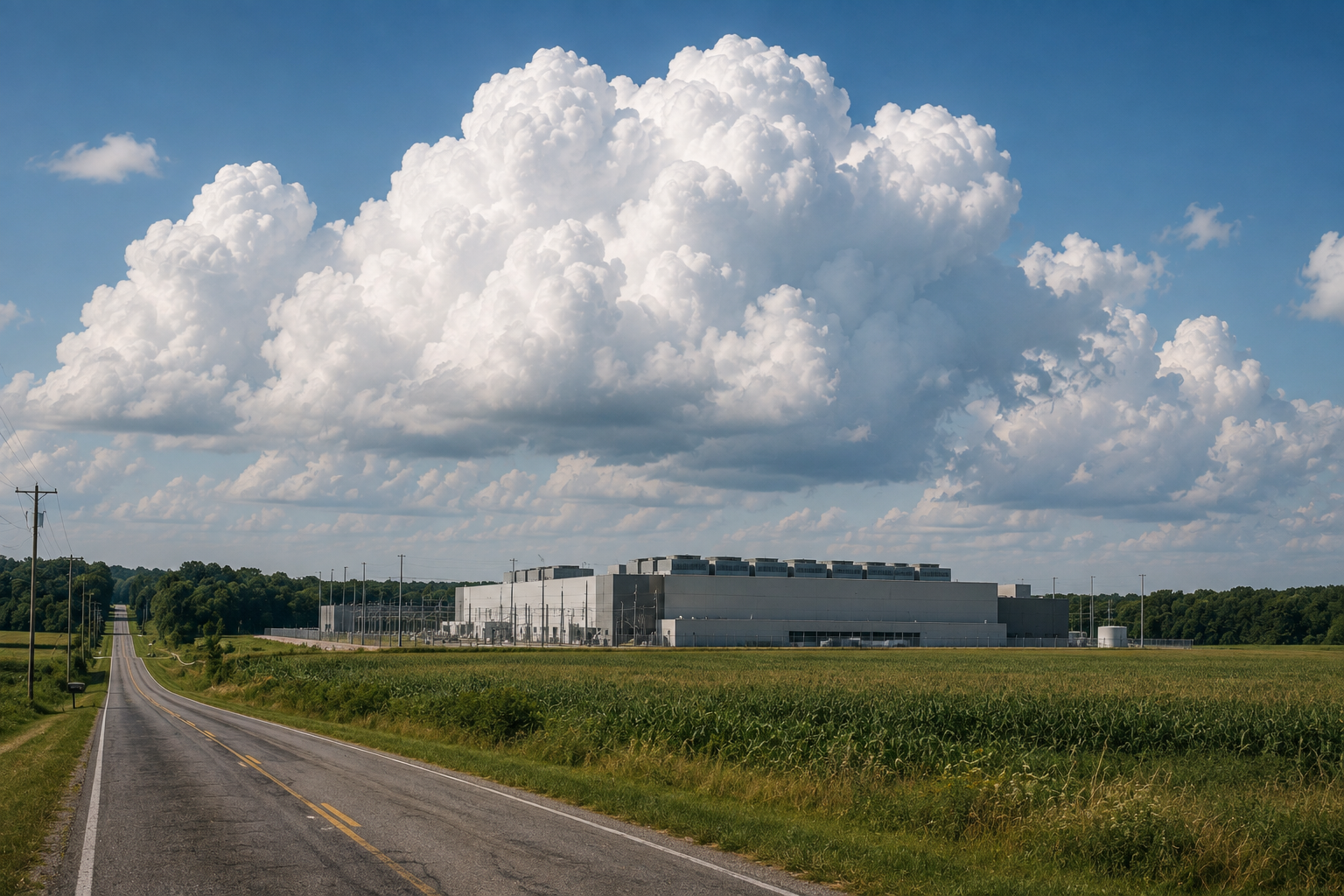
When was the last time you wondered where the cloud was?
Not what it was. Most of us have some working understanding of that. Files are stored. Photographs are backed up. Applications run. Movies stream. Emails travel. Increasingly, we can type a question into a box and have artificial intelligence respond before we have completely decided whether the question was any good.
But where did any of that actually happen?
I am wondering about it now, and I have no idea where much of my own data is physically stored. There may not even be a particularly useful answer. Files can be replicated, requests routed and workloads balanced across facilities and regions. For all I know, this paragraph went through Mars, bounced off Venus and stopped in Virginia for lunch.
Probably not. Yeah, definitely, probably not…
There was a time when computing was easier to locate. Early networks connected machines occupying actual rooms in universities, government agencies and large businesses. Even when terminals allowed users to access them from elsewhere, the relationship remained intuitive. The computer was over there. The network connected you to it.
Networking gradually complicated the pointing.
Computing began heavily centralized because computers were enormous and expensive. Personal computing distributed some of that capacity outward. Business networks created thousands of smaller centers of computation. Commercial hosting began concentrating portions of it again, and cloud computing accelerated the process by allowing organizations and individuals to use computing capacity without owning the machinery providing it.
Now some processing is moving outward again through edge computing while enormous centralized facilities continue growing. That is not necessarily contradictory. Training an artificial-intelligence model and helping a vehicle respond to its surroundings are different problems with different geographic requirements.
What changed more completely was our relationship with the machinery.
Carl Sagan warned about a society increasingly dependent upon science and technology while becoming intellectually distant from how those systems work. That observation need not be condescending. Once, a sufficiently curious person could take apart a toaster, follow the wires and develop a reasonable understanding of how it worked. Maybe the toaster never worked again, but that is one of curiosity's traditional operating expenses.
Try taking apart Windows. (Sorry Bill.)
Modern technology has created an enormous distance between ordinary curiosity and meaningful understanding. Software may contain millions of lines of code. Proprietary systems, encryption, cybersecurity, licensing agreements and intellectual-property law add additional layers. Things we casually say we bought may actually be licensed. Services replace software. Subscriptions replace purchases. The thing we use may reside on someone else's machine, and the machine may reside somewhere we have never been. On second thought, I would advise against hacking Windows. (There, lawsuit avoided.)
So, I can take and own a photograph, own the computer on which I view it and pay every month to store it while having no idea where the photograph actually is.
There are good reasons for this abstraction. Redundancy protects information. Distributed systems improve reliability. Large facilities create efficiencies. Networks route around failures.
But usefulness does not make the physical world disappear.
Perhaps our greatest linguistic trick was taking buildings filled with servers, cables, cooling equipment and electrical infrastructure, connecting them through thousands of miles of fiber and calling the result a cloud. Apparently that was still too tangible, because the industry eventually gave us the very real term "fog computing."
At this rate, cirrus, stratus, and cumulus networks seem inevitable (and meteorologists discuss going on strike).
Behind the terminology, however, land still matters. Electricity matters. Fiber, cooling, distance, climate and regulation matter. The cloud never stopped having a location. We simply stopped needing to know what it was.
Where the Cloud Landed
The internet did not spread evenly. Connections formed around universities, governments, businesses and telecommunications networks. Successful concentrations attracted more equipment, fiber and investment, creating new concentrations elsewhere. Its geography developed almost like a series of impacts, with each crater changing the landscape for what came next.
Northern Virginia became perhaps the clearest American example. Early internet infrastructure, telecommunications networks, federal activity, fiber, available land, electricity, business decisions and public policy combined over decades to create one of the world's great concentrations of digital infrastructure. Eventually concentration created its own gravity. Infrastructure attracted infrastructure.
Industries have clustered this way before. Automobiles concentrated around Detroit, finance around New York and technology around Silicon Valley. Digital infrastructure was unusual not because it clustered, but because the language surrounding it increasingly suggested that it existed nowhere.
That abstraction also created a difficult problem for government.
Imagine a local administrator who spent a career evaluating subdivisions, warehouses, factories, roads and utility extensions. Those developments came with established categories and generations of accumulated experience. Then someone arrives with a hyperscale data center involving redundant electrical feeds, fiber routes, cooling systems, backup generation, server density and electrical loads more familiar to utilities than zoning boards.
Communities have an obligation to understand what they approve, but we should also be reasonable about what that means. We built an extraordinarily complicated industry quickly and asked institutions designed around older categories of infrastructure to evaluate it. Sometimes the problem was not a failure to ask questions. It was knowing which questions needed to be asked.
At sufficient scale, the consequences become harder to treat as matters belonging only to individual properties. Electricity, transmission, land use, taxation, noise, water and other environmental effects enter public debate. Opponents can point toward those costs. Supporters can point toward investment, construction, tax revenue and technological importance.
Both can be right, and both can accomplish remarkably little by refusing to acknowledge the other.
Perhaps addressing the negative externalities is precisely what allows the benefits more time on stage.
That question becomes more important as artificial intelligence creates new demand for computing capacity and electricity while other forms of processing move closer to the devices and people using them. There may be no winner between enormous centralized facilities and more distributed infrastructure. We may need both.
For decades, one of America's persistent infrastructure questions was how to get the internet farther outward. We ran cable, laid fiber, funded rural broadband and worked on the last mile. Satellite internet is the latest chapter in that effort.
We spent a generation trying to bring data to people.
Now we also need to consider where and how the infrastructure handling that data should be built.
Putting Place Back In
Data is not electricity or water, but the comparison is becoming difficult to ignore for one reason: dependence.
Businesses use data. Schools use it. Hospitals, farms, utilities and governments use it. Children use it before they can read. Modern society increasingly depends upon the ability to move, store, secure and process information.
Unlike most infrastructure, however, much of that processing can move. A coal seam exists where geology put it. A harbor exists where geography permits it. A sewer serves the community connected to its pipes. Data can cross a continent in a fraction of a second.
That flexibility may create an opportunity to think differently about where some digital infrastructure belongs.
Wisconsin does not have Arizona's climate. Arizona does not have Wisconsin's water resources. Communities differ in their electrical grids, workforces, transportation systems, economies and environmental constraints. A facility in a cold climate might approach cooling differently than one in the desert. Waste heat might be useful in one place and irrelevant in another. Battery storage required for backup power might contribute to broader resilience. Water strategies could begin with the watershed. Environmental conditions could be measured before construction. Growth could occur incrementally as infrastructure and communities demonstrate the ability to support it.
Build. Measure. Learn. Expand.
We have dealt with similar questions of stewardship before. Municipal utilities, cooperatives, public-private partnerships and other hybrids developed because infrastructure does not always fit neatly into a choice between government ownership and detached private enterprise. Different places developed different arrangements around their own resources and needs.
Digital infrastructure may eventually require similar creativity, not because data is electricity or water, but because dependence changes the conversation.
A community recognizing the digital needs of its residents might also recognize that its land, energy, infrastructure and people can participate in meeting some of those needs. That does not tell us where every data center should go, who should own one or whether every community needs one.
It simply puts something back into the conversation that our language managed to remove.
Place.
Our digital lives may feel weightless. Their infrastructure isn't. It occupies land, draws electricity, produces heat and requires equipment, fiber, construction, workers, roads, utilities and communities.
If the digital economy increasingly depends upon those communities, perhaps the question isn't simply where we can put its infrastructure. Perhaps we should also ask what that infrastructure can do for the places that host it.
The cloud has a ZIP code.
Maybe the ZIP code should matter.
Conversation
No comments — and this piece isn't open for new ones.
Comments are closed on this piece.