Who Owns the Sewer?
And Other Questions We Should Probably Ask Before Building the Digital Future
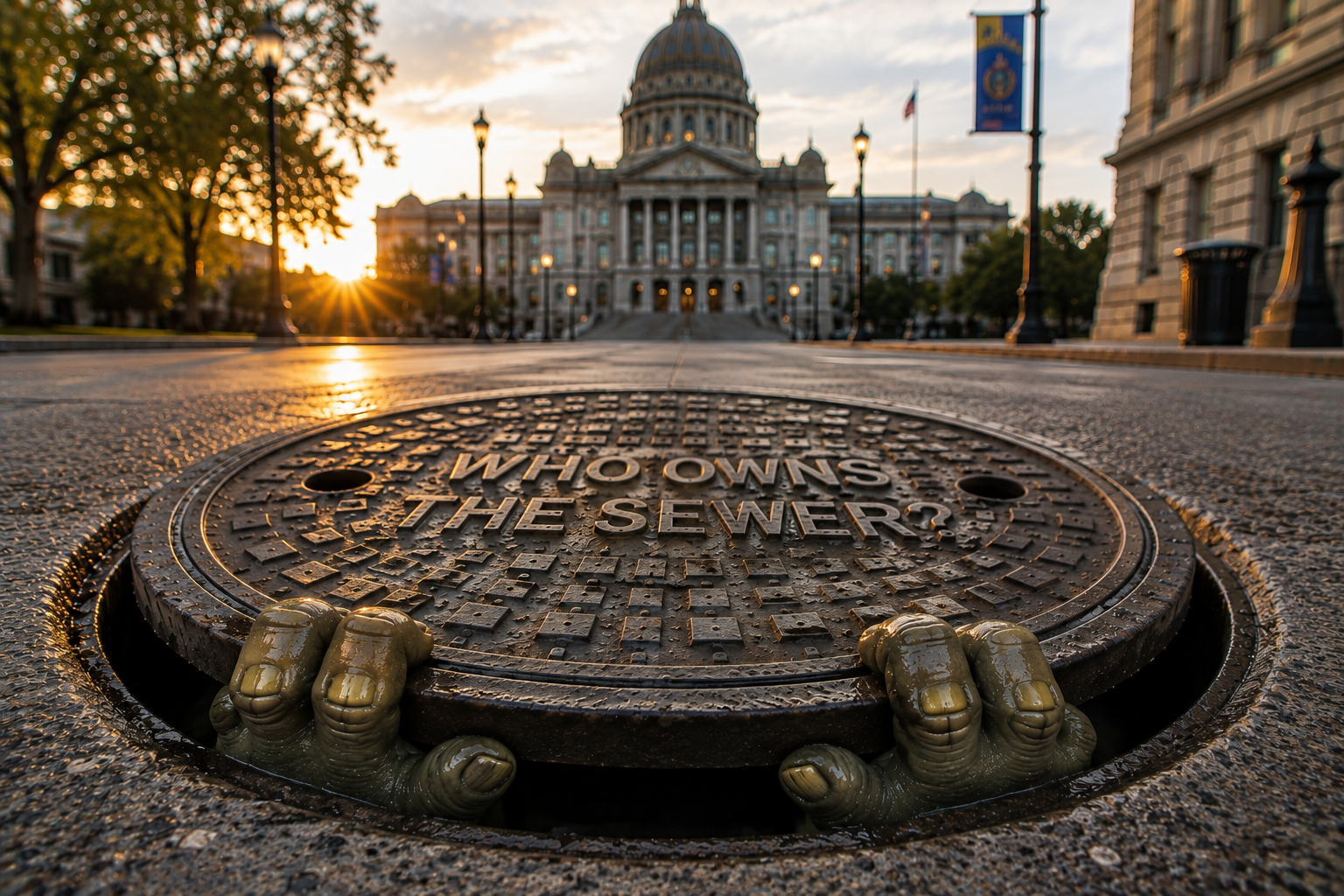
I could poop on forty acres of private land (yep, toilet humor right off the bat) and, with a little discretion, there is a reasonable chance nobody would ever know.
Try the same thing on a city parcel and your neighbor forty feet away is going to have questions. (Charlie Baileygates demonstrated rather memorably what can happen when even the dog’s moments aren’t properly managed.)
The difference is proximity. Give people enough land and distance, and sanitation can remain largely an individual problem. Move those same people closer together, multiply them by a few thousand, and eventually what happens on one person's property becomes everybody else's concern.
This is one of the less glamorous ways civilization announces itself.
The Romans understood this rather well. Ancient Rome developed an extensive system of drains and sewers, most famously the Cloaca Maxima. It was hardly modern wastewater treatment, but the Romans recognized the underlying problem: a city changes the mathematics of being human. Water must arrive somehow. Waste must leave somehow. Fire cannot simply be your neighbor's unfortunate personal matter when the buildings share walls.
Proximity turns certain private problems into civic ones.
Nearly two thousand years later, Victorian London found itself in its own stinky situation. Human waste, industrial pollution and inadequate drainage were converging in the Thames. Cholera killed thousands, and John Snow's famous investigation of the 1854 Broad Street outbreak helped establish the connection between contaminated water and disease.
Then came the summer of 1858. The Thames became so foul that the smell reached Parliament itself. History remembers it as the Great Stink. (Peeyoo!)
London responded with an enormous sewer-building program under engineer Joseph Bazalgette. The important part isn't simply that government built sewers. A practical threshold had been crossed. Enough individual sanitation decisions had become one interconnected problem that collective infrastructure made sense.
Growing at extraordinary speed and eventually rivaling London as one of the defining cities of the modern age, New York took underground infrastructure in its own distinctly American direction. The vertical city above depended upon an increasingly elaborate city below: water tunnels, sewers, subways, utilities and other systems largely invisible to the millions of people relying upon them. Those subterranean worlds also housed generations of rats, persistent legends of alligators in the sewers and, through a little ooze and a lot of pizza, four heroes in a half shell trained in the underground arts by one remarkably Zen rat. Apparently, once civic infrastructure becomes sufficiently extensive, we start giving it folklore.
The needs of the community came first. The organizational structure came later.
That gives us another category worth considering: civic infrastructure.
Civic does not necessarily mean publicly owned. Your septic tank can remain yours. Private companies can manufacture pumps. Contractors can build public systems. Utilities can take different forms. What makes infrastructure civic is more fundamental: the community increasingly depends upon the function it performs.
Who owns the sewer?
I don't know.
But I suspect what you really care about is whether you can flush the toilet.
Which brings us, naturally, to data centers.
Now Let's Talk About Data Centers
This wasn't really going to be an entire article about where Mr. Hankey goes. Data centers are having something of a sewer moment.
We want what they provide considerably more than we want the infrastructure required to provide it.
Communities across the country are confronting proposals for increasingly large facilities. Residents raise questions about electricity, water, land, noise and surrounding properties. Utilities face enormous new loads. Economic-development organizations see investment. Developers see rapidly expanding demand.
Many of those concerns are legitimate. But there is an awkward fact underneath the debate: people questioning whether we should build more data centers have not stopped using data.
Neither have I. Neither, presumably, have you. (You're reading this online, after all. Yowsers.)
We continue streaming movies, storing photographs, processing transactions, operating businesses, maintaining government records and increasingly asking artificial intelligence to do everything from analyze medical research to help write articles about sewers. (Yes, you just peeked behind the curtain. Hold that thought.)
Opposing a particular data center may change where infrastructure is built. It does not eliminate the demand requiring that infrastructure somewhere. That doesn't make opposition hypocritical; necessity does not make every implementation wise. But necessity cannot simply be wished away either.
The opposite argument is equally unsatisfying. Data centers are sometimes presented as inevitable: demand is growing, therefore infrastructure will be built somewhere, so communities should prepare themselves for progress.
Perhaps.
But "it's inevitable" is a remarkably poor way to introduce transformative infrastructure to Americans. Secrecy, inadequate public education and dismissing legitimate questions as obstacles only make that worse. If infrastructure is becoming necessary to society, that should create a stronger case for public understanding and participation, not a weaker one.
Necessity does not eliminate consent. It makes designing consent more important.
This can feel distinctly twenty-first century: technology arrives, demand accelerates, capital moves, communities struggle to understand what is coming and everyone argues about consequences nobody can completely predict.
Except there is nothing particularly twenty-first century about it.
In 1859, a man named Edwin Drake drilled a hole in Pennsylvania.
We Have Been Here Before
Drake did not discover petroleum, but his successful well near Titusville helped demonstrate that oil could be commercially extracted by drilling. Standing beside it, nobody could reasonably have imagined everything that followed: automobiles, highways, aviation, petrochemicals, plastics, global supply chains, geopolitical struggles and the environmental consequences of a civilization reorganized around fossil fuels.
The infrastructure revolutions that followed brought their own lessons. Railroads connected markets while forcing governments to confront land, safety, competition and regulation. Electricity eventually produced a combination of public agencies, private utilities, cooperatives, regulators and interconnected grids around something we now experience by simply flipping a switch.
Airports make the ownership question even more interesting. A public authority may own the terminal while private airlines fly the aircraft. Private businesses operate inside publicly financed buildings. Federal agencies regulate aviation. Local governments manage surrounding land use. Private property owners live beneath flight paths.
So is an airport public or private?
Perhaps that isn't the most useful question.
Each generation inherited lessons from the infrastructure before it: engineering, financing, regulation, land use, safety, environmental protection and public participation. We learned that transformative infrastructure creates consequences beyond its property lines and that the people living beside it do not disappear simply because people farther away depend upon it.
We also learned infrastructure need not look the same everywhere. A rural airport does not need to resemble O'Hare. An electric cooperative does not operate under the same conditions as a metropolitan utility. Even a town hall changes with geography, population, resources and need.
Why should emerging infrastructure be different?
Back to the Sewer
This wouldn't be an article without a Wisconsin story, and this one is full of, well, merde.
Milwaukee built its wastewater system to manage sanitation. Yet its treatment process eventually produced Milorganite, a fertilizer made from treated biosolids that has been sold for generations. Something entering a civic system as waste became raw material for something useful.
Airports similarly became platforms around which airlines, logistics companies, hotels, restaurants and other businesses could grow. The airport did not need to become those businesses. The infrastructure created conditions in which other possibilities emerged.
Maybe I am playing with words, and I'd like to think Frank Luntz would approve. (Frank, if you're hiring, let me know.)
But perhaps civic infrastructure is useful because it lets us ask something beyond whether infrastructure is publicly or privately owned. Once a system becomes important enough to society, we can ask how it fits its surroundings, interacts with other systems and whether the necessity that justified its existence might create opportunities beyond its original purpose.
That brings us back to data centers.
If infrastructure can evolve, why design emerging infrastructure only around its immediate function? If communities host systems serving needs much larger than themselves, what might those communities reasonably expect from the relationship?
We don't need all the answers yet.
We need enough imagination to ask the questions.
Before We Buy the Gold Shovels
Edwin Drake didn't know what came next. Neither did the first railroad builders, electrical engineers or airport planners.
We have something they didn't: their experience.
We cannot predict the future of digital infrastructure, but we know infrastructure rarely remains confined to its original purpose. Communities adapt around it. Businesses emerge from it. Regulation evolves with it. New possibilities appear.
And unlike mature infrastructure we can only redesign after the fact, we are watching this one develop around us.
So what if we treated that as an opportunity rather than an inevitability?
What should a community reasonably expect from infrastructure it helps host?
Can privately owned infrastructure serve a civic purpose without becoming public infrastructure?
Can infrastructure built to support one need create opportunities to strengthen others?
And if we were designing the physical infrastructure of the digital future today, knowing what previous generations taught us about sanitation, oil, railroads, electricity and airports, would we really design it exactly the way we do now?
Maybe.
Maybe not.
One thing seems certain: those questions are worth asking before we line up the gold shovels for the photo op.
Conversation
No comments — and this piece isn't open for new ones.
Comments are closed on this piece.