Wisconsin Cannabis and Hemp Development Act
A Wisconsin Opportunity
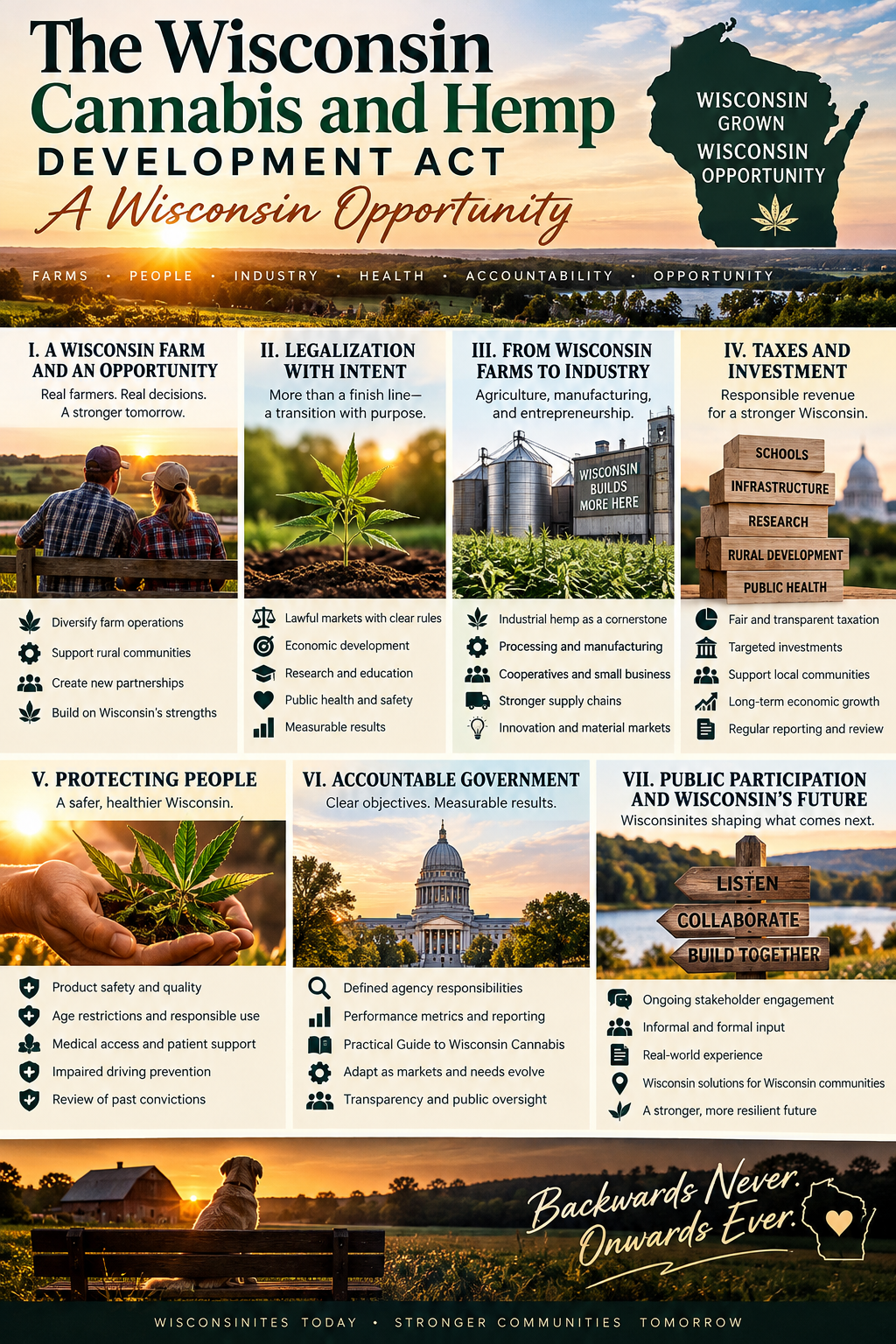
I. A Wisconsin Farm and an Opportunity
The following story could unfold every day somewhere in Wisconsin, from Prairie du Chien to North Prairie and Mosinee, up to the cities of Superior and Marinette along the borders of Lake Superior and Michigan. Imagine a husband and wife sitting at their kitchen table on a Wisconsin farm. Outside, acres stretch toward the horizon. Some have been cultivated for generations. Others offer possibilities yet to be explored.
They've spent years building their family business, learning the land, understanding its seasons, maintaining equipment, and making financial decisions accompanying every harvest. Both bring experience and perspective while continually exploring what they can provide fellow Wisconsinites. As winter approaches, they are discussing something new.
What if Wisconsin established a legal cannabis industry allowing their farm to diversify into medical cannabis, recreational cannabis, and industrial hemp? Their conversation turns practical. Which crops suit their land? Who would purchase their harvests? Could manufacturers use their hemp? What financing, insurance, and standards would apply?
They wouldn't face these questions alone. Researchers, cooperatives, financial institutions, processors, manufacturers, and purchasers could become partners. Fortunately, helping businesses navigate these questions isn't novel for Wisconsin. Chambers of commerce, county economic-development offices, regional public-private organizations, and state agencies already connect businesses, support responsible development, and encourage competition.
While this couple is hypothetical, these questions represent real decisions Wisconsin farmers and entrepreneurs would face.
Legalizing cannabis is one thing.
Creating the conditions for a sustainable Wisconsin industry is something else entirely.
II. Legalizing Cannabis as a Transition with Intent
Before Wisconsin decides what cannabis can do for its government, let's consider what a responsibly developed industry could do for Wisconsinites. Legalization would establish lawful purchasing, possession, and cultivation. Wisconsin's transition should also create agricultural markets, expand manufacturing, encourage entrepreneurship, advance medical research, and strengthen partnerships among businesses, educational institutions, and communities.
Governments undertaking legalization owe their citizens clear objectives, measurable performance, financial accountability, and a willingness to adapt. Considering the wide-ranging opportunities and challenges legalization presents for Wisconsin residents, state leaders could examine one potential solution:
The Wisconsin Cannabis and Hemp Development Act.
Rather than treating legalization as the finish line, this framework addresses the work before, during, and after establishing a lawful market. It envisions protecting consumers, supporting economic development, addressing public-health concerns, and measuring benefits to Wisconsinites.
This isn't finished legislation, nor should it be treated as such. Instead, the goal is to examine a comprehensive approach, including difficult questions and competing interests, and develop legislation capable of anticipating and responding to changing circumstances.
Legalization is a transition, not an event, and what Wisconsin does to manage the transition matters.
III. From Wisconsin Farms to Wisconsin Industry
Wisconsin's cannabis industry isn't waiting to be invented. Businesses already produce and sell THC-labeled beverages and other cannabis-related products under complicated laws and regulations. Wisconsin bars serve THC beverages. Farmers, retailers, and entrepreneurs have invested their resources in this marketplace.
The opportunity begins by recognizing what Wisconsinites have built.
The proposed Act would coordinate existing rules while establishing distinct pathways for industrial hemp, hemp-derived intoxicating products, medical cannabis, and adult-use cannabis. Established Wisconsin businesses should participate in shaping those pathways. These enterprises put food on Wisconsin families' tables.
Opportunities extend across agriculture and manufacturing. Farmers could diversify crops while working with universities to improve cultivation, genetics, and efficiency. Cooperatives could share equipment, processing facilities, and purchasers. Manufacturers could develop hemp materials for textiles, construction, automotive components, packaging, and other applications.
Industrial hemp cultivation and manufacturing must be central to this legislation.
Industrial hemp offers opportunities across materials markets. But cultivation without dependable processing capacity or customers creates risk. Supply chains require coordination among farmers, processors, manufacturers, transportation providers, and purchasers.
Wisconsin already possesses agricultural, industrial, and economic-development institutions capable of connecting these opportunities. Revenue from taxes and fees could support targeted research, infrastructure, and industry development, helping Wisconsin products reach residents, visitors, and broader markets.
Agricultural insurance belongs in this effort. Federal programs cover certain industrial hemp operations, while other cannabis cultivation faces different barriers. Existing Wisconsin institutions could examine gaps and coordinate lawful solutions.
Small enterprises also need proportionate licensing, cooperative opportunities, mentoring, succession planning, safeguards against excessive market concentration, and assistance navigating banking restrictions. As businesses mature, specialized government assistance should evolve with demonstrated needs rather than become permanent.
Wisconsinites-first legislation doesn't promise immediate revenue booms or success for every enterprise. Farmers must grow viable crops. Manufacturers need competitive products. Entrepreneurs must attract customers, manage costs, and build dependable relationships.
Government's role is to build bridges between opportunities, not guarantee profits or pick winners and losers.
The result envisioned is an interconnected Wisconsin industry, growing from local partnerships to statewide and broader markets.
IV. Taxes, Enforcement, and Responsible Investment
A new industry raises an important question: How should Wisconsin collect revenue without restricting the opportunities it intends to create?
The proposed Act would begin with a modest cannabis excise tax. Farmers, processors, retailers, and entrepreneurs face substantial entry costs. Licensing, equipment, facilities, insurance, financing, and compliance require investment before earning their first dollar.
Taxation shouldn't prioritize maximizing immediate state collections. Predictable conditions allowing businesses to enter, compete, and grow give entrepreneurs a clearer path toward their goals.
Lower taxes don't automatically produce greater revenue. Rates influence prices, participation, consumer behavior, and competition with unregulated markets. Wisconsin should evaluate economic scenarios rather than presume any rate guarantees success.
Legalization also changes government expenditures. Reduced possession-related enforcement could free law enforcement, court, and correctional resources for other responsibilities. Redirected resources aren't necessarily budget savings. Licensing, inspections, testing, education, and enforcement introduce costs.
The Act would require transparent accounting and direct revenue toward identified regulatory, public-health, research, and economic-development purposes.
With participation from Wisconsinites already operating cannabis businesses, lawmakers would establish objectives, standards, and reporting requirements. Economists, agricultural specialists, healthcare professionals, law enforcement, and industry representatives would evaluate outcomes and recommend adjustments.
Assessments would examine business entry, market concentration, consumer access, public safety, regulatory costs, economic development, and revenue. Recommendations could include alternative tax scenarios and projected consequences.
Elected representatives would retain responsibility for amendments. Evidence would inform legislative judgment, not replace it.
The objective isn't simply collecting more revenue. It's developing a sustainable Wisconsin economy where public investment, responsible regulation, and private enterprise support lasting opportunities.
V. Protecting People While Expanding Opportunities
Economic development and public protection aren't competing responsibilities. A sustainable cannabis industry depends on consumers, patients, families, and communities trusting its products, businesses, and regulations.
The proposed Act would establish testing, labeling, traceability, and quality-control standards. Consumers should understand potency, ingredients, precautions, and potential risks. Businesses need clear responsibilities, and regulators need effective means of identifying unsafe products.
Protecting Wisconsin's children should inspire some of the legislation's most thorough debate. Opposition to cannabis sometimes reflects multigenerational beliefs shaped by decades of public messaging rather than personal experience with its potential benefits. These perspectives deserve discussion, not dismissal. Age restrictions, responsible retailing, secure packaging, and education developed with healthcare and educational professionals warrant public examination.
Rallies and advocacy events should continue, but Wisconsin also needs forums where differing opinions and professional expertise receive mutual consideration. Parents and educators deserve practical information about youth access and early cannabis use, not exaggerated warnings undermining credibility.
Wisconsin's patients deserve equally thoughtful attention. Medical access should include reliable products, clear information, and consultation with qualified healthcare professionals. Patients and caregivers need to understand potential benefits, limitations, medication interactions, and uncertainties in medical evidence. Affordability, continuity of access, and accommodations for patients unable to travel also matter.
Public safety extends beyond sales. Impaired-driving prevention requires education, enforcement training, and evaluation of detection methods. Legal possession never permits impaired driving. Justice reform belongs in this transition. Wisconsin should review past cannabis convictions, distinguish newly lawful conduct from more serious offenses, and consider appropriate expungement or remedies.
Government should explain regulations clearly to consumers, patients, caregivers, parents, businesses, and communities. Public participation and professional expertise should help evaluate protections.
Legalization changes government's responsibilities; it does not eliminate them.
A responsible transition is measured not only by businesses opened, but by whether Wisconsinites can participate with confidence, informed choices, and meaningful protections.
VI. Government That Learns, Measures, and Adapts
Passing legislation requires responsibility. Maintaining, improving, and entrusting it to future generations requires stewardship.
Wisconsin has a rich history of discovery extending well beyond its borders, including two pioneering women whose passions and persistence crossed disciplines, geographic boundaries, and conventional expectations. Born in Stevens Point, Harriet Bell Merrill was a freshwater scientist whose research and travels extended into South America. Her story reflects Wisconsin's capacity to cultivate curiosity, pursue discovery, and contribute knowledge beyond its borders. Raised in Madison, Eliza Ruhamah Scidmore became a journalist, photographer, and the first woman to serve on the National Geographic Society’s board. Venturing from Alaska to East Asia, Eliza expanded Americans’ understanding of distant places through her words and pictures. Her dedication to connecting cultures helped bring Japan’s cherry blossom trees to Washington, D.C., creating a lasting symbol of international friendship.
Wisconsin's schools, colleges, universities, and researchers continue that tradition. Their discoveries don't stop at state lines, and neither should Wisconsin's willingness to learn. Interdisciplinary teams could visit states with established cannabis markets, observe operations, examine successes and failures, and return with practical recommendations. Lessons learned elsewhere could strengthen Wisconsin's own approach.
Before creating new offices, Wisconsin should examine capabilities within government, universities, and existing institutions. Additional structures should address demonstrated needs. Accountability requires accessible reporting of expenditures, business participation, market development, public-health outcomes, enforcement, and unintended consequences. Findings should inform legislative review.
Programs should be evaluated against objectives rather than arbitrary deadlines. Assistance essential during early development may become unnecessary as businesses mature. When needs decline, government should adapt, reduce, or discontinue specialized support. The resulting legislation should be enduring and adaptable, but its programs and supporting structures should not continue indefinitely without careful consideration of their impacts on Wisconsinites.
Transparency must extend beyond financial reports. The Act would maintain a Practical Guide to Wisconsin Cannabis alongside its legislative text, explaining provisions in language Wisconsinites understand. Amendments would prompt explanations of what changed, why, and how residents are affected. The goal isn't eliminating complexity. It's ensuring government explains decisions in terms Wisconsinites can understand and evaluate through their elected representation.
If government cannot explain what it is doing, why elected leaders are doing it, and how they will determine whether it worked, government has more work to do.
VII. An Invitation to Build the Framework
The Wisconsin Cannabis and Hemp Development Act shouldn't be treated as finished legislation. It's a developing framework strengthened through participation by those it serves.
This is Wisconsin's opportunity to shape its future.
Farmers, entrepreneurs, manufacturers, medical professionals, patients, educators, financial institutions, law enforcement, residents, and elected representatives bring experiences and knowledge that offer distinct perspectives on Wisconsin's future.
Legalizing cannabis shouldn’t mean neglecting the opinions of those opposing legalization. Their concerns, emotions, and ideas can help Wisconsin consider how to prevent patterns of excessive consumption resembling those associated with tobacco throughout much of the 20th century. Strong disagreement exposes overlooked risks, competing priorities, and unintended consequences. These concerns deserve open examination, evidence, and practical alternatives.
Elected leaders must reconcile competing interests rather than turn disagreements into political victories, fundraising opportunities, or reasons to abandon the conversation. Public participation would refine the legislation and its Practical Guide to Wisconsin Cannabis, strengthening understanding and accountability.
Return to the husband and wife at their Wisconsin farmhouse kitchen table. Their opportunity depends on more than legalizing a new crop. It depends on the markets, partnerships, protections, and institutions Wisconsin chooses to develop.
The same holds true for future generations.
The question isn't simply whether Wisconsin should legalize cannabis. It's what Wisconsin could accomplish through a carefully designed transition.
Conversation
No comments — and this piece isn't open for new ones.
Comments are closed on this piece.